


Buying tickets for fan events and collectible merchandise online has long been routine. Along with the convenience, the risks have grown: scammers copy websites, post fake listings and rush buyers. This article covers the signs of a reliable seller, the protection each payment method offers, rules for handling personal data and a practical example of the checks used in the regulated online casino industry.
Why Buying Tickets and Merchandise Online Requires Separate Checks
Fan events and collectibles are characterised by high demand and limited supply. These conditions attract scammers. According to Action Fraud, 9,826 reports of ticket fraud were received in 2024, with reported losses of £9.7 million, almost 50% more than the year before. Scarcity and limited sale windows push people toward quick decisions, and haste reduces attentiveness.
It is advisable to cross-check information about scam schemes across several sources, including Action Fraud data, media publications and the organisers’ official pages. The final decision to buy, however, should rest on checking the specific seller. Sources only show which schemes are most common.
Announcements of major events increase interest in tickets. For 2027, events already announced include Force Fest in Cheltenham and the Star Wars: The Experience exhibition in Philadelphia, with tickets going on sale in November. Around news like this, it is especially important to tell official channels apart from random offers.
A Case from Online Casinos: What a Regulated Industry Shows About Verification and Payments
Online casinos in the UK operate under the supervision of the Gambling Commission, so their procedures offer a clear example of verification. Operator reviews, including roundups at PremiumTimesng UK, show that the level of player protection depends on the licence and jurisdiction. The regulator requires licensed operators to verify the age and identity of customers. The Commission’s Chief Executive, Andrew Rhodes, has previously described the supervisory task this way: “our role is to allow gambling to take place as long as it is safe, fair and free from crime”.
The table below compares the public requirements for a licensed online casino with the checks applicable to buying tickets and merchandise. The case is based on the regulator’s public rules and does not describe a specific operator.
| Criterion | Licensed online casino in the UK | Buying tickets and merchandise |
| Licence | Gambling Commission licence, details of which can be checked against the public register | There is no single licence; the benchmarks are the organiser’s official partners and the seller’s legal details |
| Identity verification | The customer’s age and identity are confirmed before play begins | There is usually no mandatory verification of the buyer’s identity, so it is the seller who has to be checked |
| Payment protection | Protection is based on licence rules and the payment service’s terms | Protection depends on the payment method; details are in the payment section below |
| Customer data | Processing follows data protection rules, with clear storage terms | A privacy policy and a secure payment page |
| Public verification | Licence register, terms and responsible gambling rules | The organiser’s website, registered address, refund terms |
The main takeaway from this case is transparency. A reliable platform explains in advance which documents will be required and why, and clear terms are a sign of good faith. For ticket purchases, the same principle means being wary of a seller who avoids questions about refunds, fees and data processing. Operators outside a UK licence are not subject to UK requirements, so checking the licence remains the key step.
How to Check a Seller Before Paying
Checking a seller takes a few minutes and reduces the chance of losing money. It is best to start with the event’s official pages, which list authorised sales partners. Next, assess the technical and legal signs of the site itself. If the organiser does not name its partners, it is worth contacting its support team.
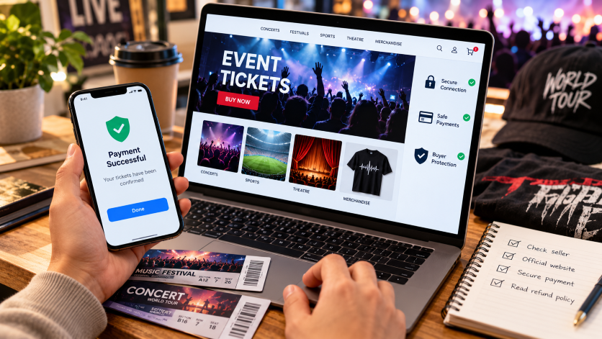
The main signs of a reliable seller:
- an exact website address with no extra characters or substituted letters;
- the STAR logo, indicating membership of the Society of Ticket Agents and Retailers;
- the company’s legal details, address and working support contacts;
- clear terms on refunds, fees and delivery before payment;
- no requests to move to a messenger app or to pay by transfer outside the platform.
Special attention is needed for offers on social media. Almost half of the 3,700 reports of concert ticket fraud in 2024 involved listings on such platforms. Private messages, closed groups and urgent requests to transfer money are considered high-risk areas. A sharp discount on a sold-out event is also a reason for caution.
With merchandise, the schemes are similar. Collectible sets such as the LEGO UCS Executor Super Star Destroyer 75457, with 6,000 pieces, are usually expensive, so buying from an unknown seller carries the risk of a large loss. It is advisable to compare the price with the brand’s official store and look for reviews on independent platforms. Before buying, it is also worth searching for the seller’s name together with the words “reviews” and “complaints”.
Payment Methods and Buyer Protection
The payment method affects the chances of getting your money back no less than the choice of seller. A credit card provides additional legal protection under Section 75 of the Consumer Credit Act 1974. In that case, the card issuer is jointly liable with the seller if the goods or services cost more than £100 and no more than £30,000.
There is an important caveat: the protection applies to a single item costing more than £100. A £99 ticket with a £5 service fee is not covered by Section 75. For such purchases, a chargeback on a debit or credit card remains an option; it has no minimum amount threshold, but it is not a statutory guarantee of a refund. Section 75 does not apply to gambling, which distinguishes that sector from buying tickets and merchandise.
Comparison of the main payment methods:
- credit card: Section 75 for individual items costing more than £100 and up to £30,000 when paying the seller directly;
- debit card: chargeback with no minimum amount and no statutory guarantee; the claim is usually filed within 120 days;
- payment services: terms depend on the intermediary, and a credit card purchase made through PayPal does not receive Section 75 cover, except in cases involving PayPal Credit;
- bank transfer to a stranger: the money leaves immediately, and a refund is possible only under reimbursement rules.
Since October 2024, UK banks have been required to reimburse losses from fraud in which the customer authorised the transfer themselves. Nevertheless, prevention remains more reliable than recovery, since the procedure takes time and requires the circumstances to be confirmed. So before sending money, it is worth stopping to check the recipient.
Ticket Resale and Buyer Rights
The rules on ticket resale in the UK are in the process of changing. In the King’s Speech on 13 May 2026, the government confirmed its intention to introduce a bill banning ticket touting. It provides for a ban on resale above face value, a cap on platform fees and an obligation for platforms to monitor compliance with the limit.
Football tickets are not covered by the new regime: their sale is already regulated by the Criminal Justice and Public Order Act 1994. At the time of publication, these are planned rules, so the current rules of the platform and the organiser should be checked separately.
Ticketmaster UK has stated that since 2018 it has limited resale on its platform to face value, and it supported the introduction of an industry-wide cap. This is an example of how large platforms publish their resale rules in advance. For the buyer, such rules serve as an additional benchmark when choosing a platform.
The right to cancel deserves separate attention. Tickets for an event on a specific date are, as a rule, excluded from the 14-day cancellation period for distance purchases, whereas for merchandise this right usually applies after the goods are received. It is advisable to read the refund terms before paying, not after.
Protecting Personal Data and Accounts
A purchase requires sharing your name, address, email and payment details, so a leak or phishing attack can cause harm unrelated to the transaction itself. Action Fraud recommends using strong, unique passwords made of three random words for your email and shopping accounts. Suspicious emails can be forwarded to report@phishing.gov.uk.
Basic data protection measures for online purchases:
- a separate password for your email and for the seller’s account;
- two-factor authentication wherever it is available;
- never sharing SMS codes or card photos with supposed support staff;
- paying only on a secure page that clearly shows the seller’s name;
- saving screenshots of the listing, the correspondence and the payment confirmation.
Saved documents make it easier to contact the bank or the seller. In a dispute, they prove what exactly was promised, on what terms and at what moment. It is also recommended to check your card statements periodically and spot unknown charges in good time. When buying merchandise from international stores, it is also worth keeping records of customs charges and delivery times.
The final sequence of actions for the buyer includes checking the official source, choosing the payment method with the strongest protection, keeping confirmations and being careful with data. This set of measures does not eliminate risk entirely, but it significantly reduces the likelihood of losses when buying tickets and merchandise. Regularly checking terms, sources and payment methods turns from a one-off measure into a habit that protects a collector’s budget.