



If the Force is everywhere, in everything, can a Jedi ever truly isolate?
 Obi-Wan Kenobi struggles with this, among other issues, in the immediate aftermath of the formation of the Empire, in John Jackson Miller’s 2013 novel, Kenobi. The story was conceived by Miller in 2006, after the 2005 theatrical release of Revenge of the Sith. The book is a magical introduction to the outcast Jedi’s arrival to Tatooine, complete with an almost immediate reference to a “tiny baby with a wisp of blonde hair.” But the greatest impact of the tale could be the influence it has had on the launch of Disney Plus Star Wars stories that suggests its deeper genius and depth.
There is an introduction to the mythology and history of the Sand People, known by settlers as Tusken Raiders for their attack on Fort Tusken, and especially how it relates to non-indigenous outsiders. The novel provides an expansion to the footprint of locations and beasts on Tatooine—a sand-soaked blueprint for existence on the desert planet of the dual suns. There is also a specific live-action character who may have been derived from the pages of the essential legends collection novel. The DNA of this single story appears to have been transfused into aspects of The Mandalorian and The Book of Boba Fett (BOBF), garnering extra attention while leading up to the newest tentpole limited series, Kenobi—set 8-9 years after the timing of the book—on deck for its May 27 release.
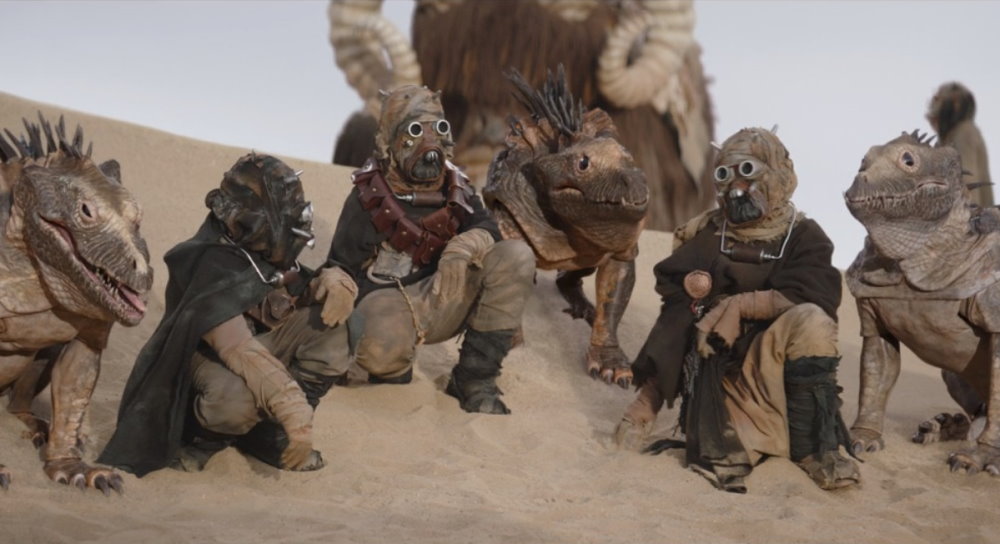 In the book, A’Yark is the leader of the Sand People tribe engaged with the moisture farmers in their part of the Tatooine desert, the Jundland Wastes, between the Northern and Western Dune Sea. Aspects of their history and daily life are reminiscent of Boba Fett’s experience with the small tribe that found him near death at the Great Pit of Carkoon, after escaping the sarlaac. On the Disney Plus show they captured Boba and tested him constantly—both physically and mentally—to see if he could be of true value to the tribe. A’Yark spoke (yes, spoke!) of similar tests that most kidnapped settlers didn’t survive, even though some rules of engagement were lightened due to the drastically declining number of Tusken Raiders. Both groups held water sacred, were vicious in battle, and were extremely skeptical of non-Sand People. Much like Boba earned his place among the Tusken Raider tribe, a former Jedi named Sharad Hett, did the same in A’Yark’s tribe. The Jedi inspired and strengthened the tribe until his demise by Hutt during a battle with the criminal underground. This led to A’Yark, a non-traditional female tribe leader, to take the reigns of her people and their future. I see this being recognized in BOBF through the lead warrior who trains Boba Fett in the ways of gaderffii stick combat—also a gifted female warrior, if not specifically called out during the show.
 At a higher level of Tusken Raider mythology is A’Yark’s explanation of the dual suns of the planet. They were brothers until the younger sun “showed his true face to the tribe.” The Sand People did not show their skin at all, labeling it as a sin and embracing this approach to their physical existence of their harsh desert climates. The older brother attempted to exact revenge on his disowned brother, but failed to kill him—plunging them both into an eternity of chasing one another across the sky. There might be no better way of explaining what Obi-Wan Kenobi experienced with his former Padawan, Anakin Skywalker. It will be interesting to see if and how aspects of this story are touched upon once episodes of Kenobi are streaming, but at the very least it is a relative fable to the tragic circumstances of the one-time Jedi brothers.
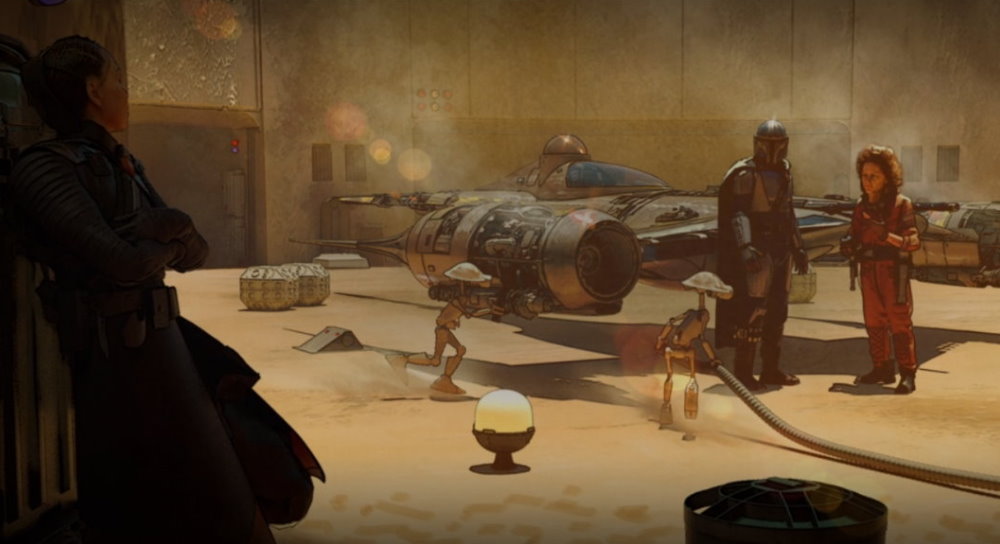 On a much lighter topic, a primary influence on The Mandalorian series by the Kenobi novel is that of a specific character. Annileen Calwell is the widowed shopkeeper of the Dannar’s Claim general store at Pika Oasis on Tatooine. She comes to befriend “Ben” Kenobi after he saves her daughter, Kallie, during a runaway dewback escapade (where A’Yark actually sees the Force at work but thinks it is Annileen wielding the power), and is intrigued by the lone wolf stranger who purchases some supplies from her. “Annie” is an independent woman and business owner in charge of a large operation that serves as the central social hub of the region. She has an at-times gruff approach, short fuse, and big, caring personality—very similar to Peli Motto, the mechanic, hangar 35 manager, and sabacc player who has a soft spot for Grogu when Din Djarin arrives for ship repairs. It was difficult to read Annie’s parts in the book without seeing Peli as the character, which was definitely a fun aspect of the reading experience.
These are just the tip of the Sandcrawler (as I didn’t even mention the Krayt dragon). I’m not exactly sure what to expect from the Disney Plus limited live-action series Kenobi, but I’m eager to see how the book of the same title has any influence on the show, whether directly or indirectly.