


The Phantom Menace 25: Gary Rydstrom on mixing the sounds of Episode I

- Advertisement -
- Advertisement -

Writing over at StarWars.com, Lucas Seastrom continues his series of articles looking at the creative minds behind the sounds and images of The Phantom Menace, and here he chats with Sound Mixer Gary Rydstrom who walks us through the processes and challenges of helping craft an entirely new era of Star Wars.

Rydstrom joined The Phantom Menace crew during post-production as a re-recording mixer, which he describes as “a funny term. It’s called re-recording because we’re putting sounds that have already been recorded into the mixing board. Whether it’s music, dialogue, or sound effects, it’s been recorded somewhere else, prepared for us, and we’re taking all of this stuff onto the mixing stage and recording it again to make it sound like the finished movie.”
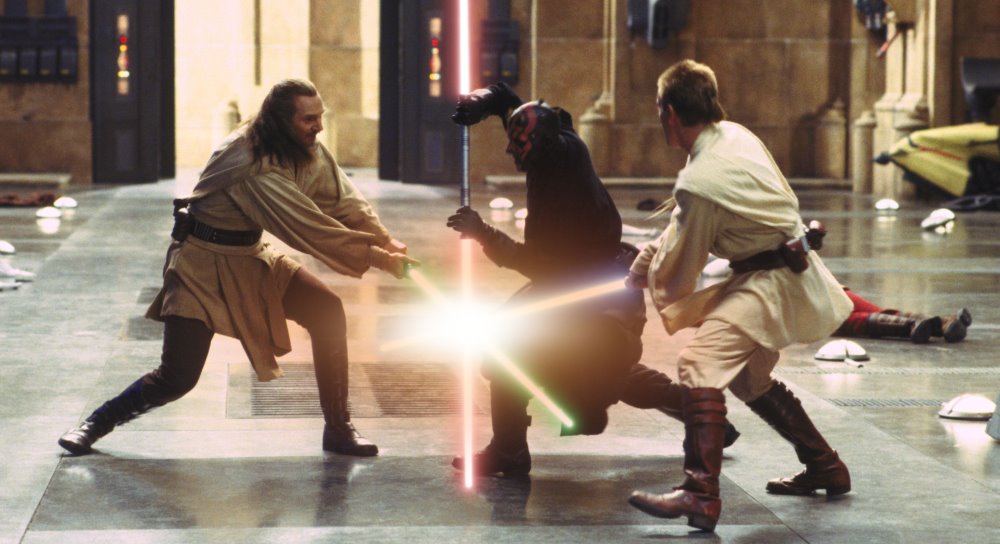
The mixing tasks on Phantom Menace were split between three crew members. “I mixed the sound effects,” Rydstrom says, “including lightsabers, explosions, R2-D2, lasers, and all that kind of stuff. I set the levels so that one thing is louder than the other or I take things out if it’s not necessary. I can also add panning. If you have a lightsaber fight — and I think Phantom Menace has some of the better ones in all of Star Wars — you’re placing those sounds on the screen so they come from specific speakers around you.”

Tom Johnson, who had been a classmate of Rydstrom’s in the University of Southern California’s cinema program, mixed the film’s dialogue. Shawn Murphy took the music tracks. “Shawn was not only a re-recording mixer,” notes Rydstrom, “but he was also a ‘recording mixer,’ if you want to put it that way, because he actually recorded the score with John Williams and the orchestra. He recorded ‘Duel of the Fates’ and everything else on the scoring stage, so he knew the music inside and out.”

Mark Newbold
Mark Newbold
Exploring the galaxy since 1978, Mark wrote his first fan fiction in '81 and been a presence online since his first webpage Fanta War in 1996. He currently contributes to ILM.com and SkywalkerSound.com, having previously written for Star Wars Insider, StarWars.com, Star Wars Encyclopedia, Build The Millennium Falcon, Starburst Magazine, Geeky Monkey, TV Film Memorabilia and Model and Collectors Mart. He is a four-time Star Wars Celebration Stage host (the only podcaster to have appeared on every Celebration podcast stage since it began in 2015), the Daily Content Manager of Fantha Tracks and the co-host of Making Tracks, Canon Fodder and Start Your Engines on Fantha Tracks Radio.
- Advertisement -
- Advertisement -

Writing over at StarWars.com, Lucas Seastrom continues his series of articles looking at the creative minds behind the sounds and images of The Phantom Menace, and here he chats with Sound Mixer Gary Rydstrom who walks us through the processes and challenges of helping craft an entirely new era of Star Wars.

Rydstrom joined The Phantom Menace crew during post-production as a re-recording mixer, which he describes as “a funny term. It’s called re-recording because we’re putting sounds that have already been recorded into the mixing board. Whether it’s music, dialogue, or sound effects, it’s been recorded somewhere else, prepared for us, and we’re taking all of this stuff onto the mixing stage and recording it again to make it sound like the finished movie.”

The mixing tasks on Phantom Menace were split between three crew members. “I mixed the sound effects,” Rydstrom says, “including lightsabers, explosions, R2-D2, lasers, and all that kind of stuff. I set the levels so that one thing is louder than the other or I take things out if it’s not necessary. I can also add panning. If you have a lightsaber fight — and I think Phantom Menace has some of the better ones in all of Star Wars — you’re placing those sounds on the screen so they come from specific speakers around you.”

Tom Johnson, who had been a classmate of Rydstrom’s in the University of Southern California’s cinema program, mixed the film’s dialogue. Shawn Murphy took the music tracks. “Shawn was not only a re-recording mixer,” notes Rydstrom, “but he was also a ‘recording mixer,’ if you want to put it that way, because he actually recorded the score with John Williams and the orchestra. He recorded ‘Duel of the Fates’ and everything else on the scoring stage, so he knew the music inside and out.”

Mark Newbold
Mark Newbold
Exploring the galaxy since 1978, Mark wrote his first fan fiction in '81 and been a presence online since his first webpage Fanta War in 1996. He currently contributes to ILM.com and SkywalkerSound.com, having previously written for Star Wars Insider, StarWars.com, Star Wars Encyclopedia, Build The Millennium Falcon, Starburst Magazine, Geeky Monkey, TV Film Memorabilia and Model and Collectors Mart. He is a four-time Star Wars Celebration Stage host (the only podcaster to have appeared on every Celebration podcast stage since it began in 2015), the Daily Content Manager of Fantha Tracks and the co-host of Making Tracks, Canon Fodder and Start Your Engines on Fantha Tracks Radio.
- Advertisement -
- Advertisement -
- Advertisement -