


Based on a harrowing real-life story, The Lost Bus starring Matthew McConaughey and America Ferrera heavily features VFX by ILM, and writing over at ILM.com, Jay Stobie dives into the visual effects work that brought this incredible series of events to life, including breaking down reference material of the actual fire in order to recreate them for the movie.
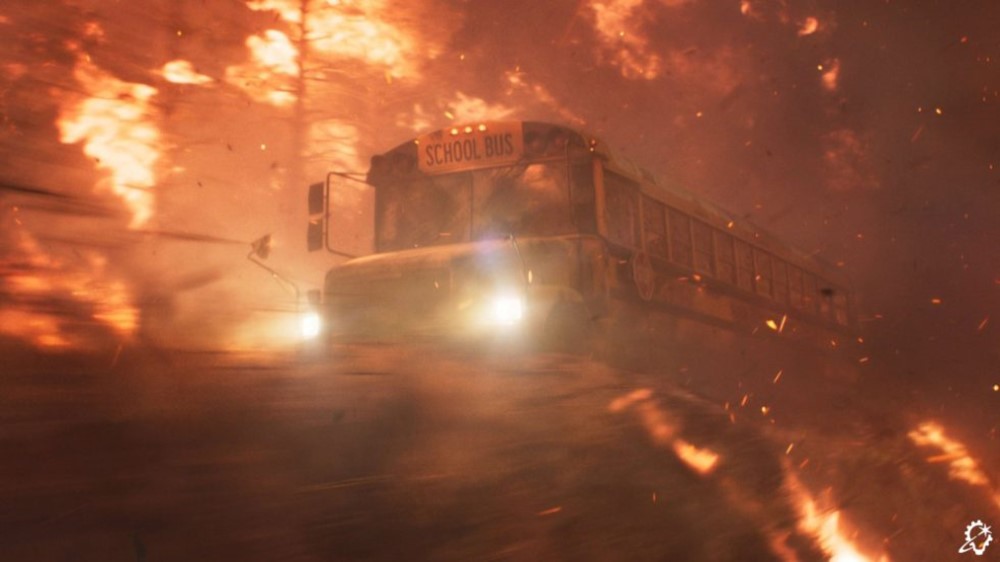
Inspired by the events of the 2018 Camp Fire in Paradise, California, and based on Lizzie Johnson’s 2021 book “Paradise: One Town’s Struggle to Survive an American Wildfire,” The Lost Bus (2025) follows Kevin McKay (Matthew McConaughey) and Mary Ludwig (America Ferrera) as they attempt to shepherd 22 children to safety aboard a school bus during a chaotic evacuation. Directed by Paul Greengrass (The Bourne Ultimatum [2007], Captain Phillips [2013]), who co-wrote the screenplay with Brad Ingelsby, the film puts the audience in the front seat on a harrowing ride through the awful inferno.
As the ILM visual effects supervisor, Zaretti operated out of the London studio and oversaw the company’s work on the project. “I think ILM had the lion’s share of the visual effects work for the second part of the film,” Zaretti tells ILM.com. “I supervised all of the London work, and we had work from ILM’s Mumbai studio that [ILM associate visual effects supervisor] Steve Hardy supervised. My daily role was to keep an eye on the overall vision of the show and check in with Charlie Noble, the client-side visual effects supervisor.”
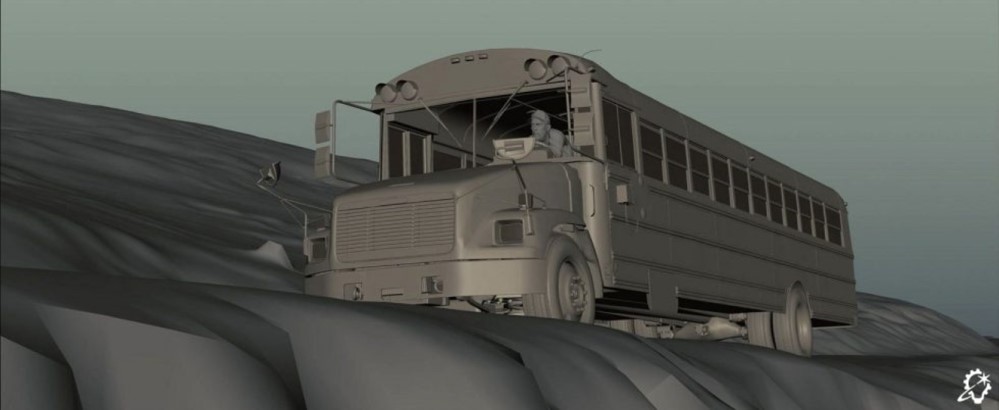
Noble supplied ILM with what Zaretti describes as a nearly two-hour-long “megaclip” of reference material, which helped ILM ground their visual effects shots in realism. “I’ve never had so much reference on a show,” Zaretti emphasizes, “because this event occurred in 2018, and everyone had phones and cameras. It was a very filmed event. A pickup unit also went to Paradise and filmed loads of additional footage of the actual place itself. In terms of the environment and road layouts, we spent a long time on Google Maps ensuring we got all of the turns in the road correctly.”
ILM broke up the reference megaclip into separate asset types. “We had shots within the smoke cloud, shots outside of the smoke cloud, big fires, small fires, brush fires, trees burning, houses burning, and cars burning,” Zaretti recalls. “There were fire tornadoes; I didn’t even know that was a thing! We were spoiled with references to the point where the references began to contradict each other because there’d be wind blowing in two different directions in the same piece of footage. Those contradictions actually helped us in certain scenarios. For example, during the escape sequence when the bus is winding down this thin road, there are points where we had flames licking at it from both directions to portray the danger that they were in. So, having a real reference to back up your visual effects often helps.”