


ILM.com: “The One With The Whales” – ‘Star Trek IV: The Voyage Home’ with John Goodson

- Advertisement -
- Advertisement -

Forty years ago, arguably the most popular of all Trek films landed with a splash in US cinemas, telling the story of a veteran crew travelling back in time to retrieve two humpback whales and take them back to the future. Star Trek IV: The Voyage Home set new standards for visual effects, and writing for ILM.com I had the good fortune to chat with modelmaker John Goodson about the creation of those whales, George and Gracie.
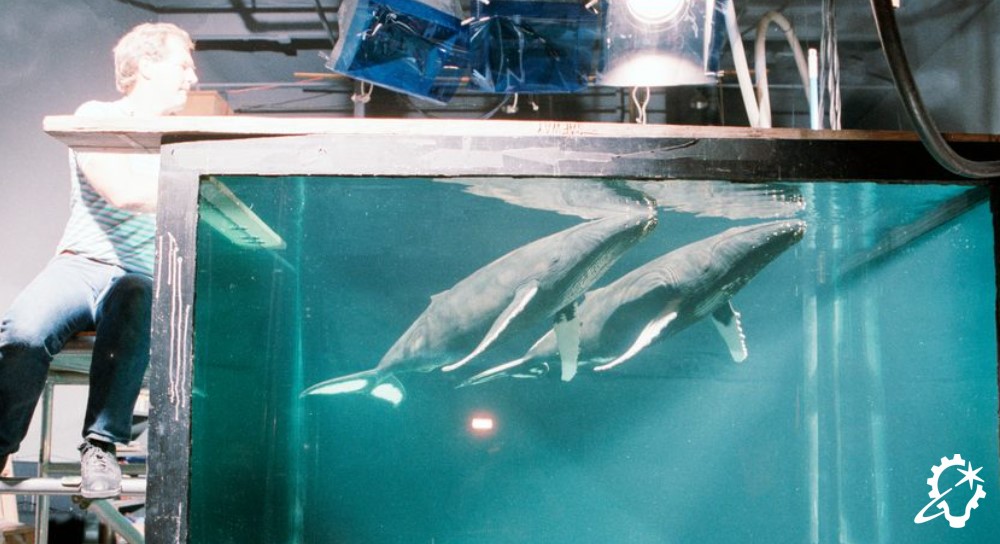
With the whales now built, they had to be filmed, and an unlikely location became their “oceanic home.” “There was a school in San Mateo with a 17-foot pool and a room downstairs with a window they could film through,” says Goodson. “Don Dow was the effects supervisor, and we went down with underwater cameraman Pete Romano and two assistants, one of whom was Toby Heindel.”

Each whale required two people to operate it: one to control its direction via tail movements and one to control the flippers, while two additional handlers held the whales until the camera rolled. “Their job was to put the whales back to the start position, and then they would swim through the shots,” recalls Goodson. “I was video recording for Don Dow during the shots and doing playback, as well as preventing the hull of the whaling ship from hitting the side of the pool. They would point it at one side of the pool and let it go to shoot the whales and the boat going overhead.”

That boat was the infamous whaling ship, and a version of it has since been on display at ILM’s San Francisco studio for many years. “Dick Dova was one of the grips, and one of his jobs was to mount a stage light over the water,” Goodson says. “The lower doors of the Klingon Bird-of-Prey were made of wood and were pretty crude, but when they opened, the light would shine down. Dickie put diatomaceous earth into the water, and that gave them the ‘god rays’ of light the whales would swim through.”

“We learned to be very careful to shoot the whales only at certain angles,” said Walt Conti back in 1986. “Technically, shooting the whales swimming from underneath was a great way to see them because it made them look so much larger, but most people are not accustomed to seeing a whale from that position, and so it didn’t really work. Audiences are used to seeing these animals photographed from specific angles, and if you deviate too much from that, it just doesn’t seem real to them.”

SourceILM.com
Mark Newbold
Mark Newbold
Exploring the galaxy since 1978, Mark wrote his first fan fiction in '81 and has been a presence online since webpage Fanta War in 1996. He is the EiC and Daily Content Manager of Fantha Tracks and currently contributes to ILM.com, SkywalkerSound.com, Star Wars – Das Offizielle Magazin, Journal of the Whills and Starburst Magazine, having previously contributed to magazines Star Wars Insider, Geeky Monkey, TV Film Memorabilia, Model and Collectors Mart, partworks Build Darth Vader, Star Wars Encyclopedia, and Build The Millennium Falcon, and websites Jedi.net, Jedi News, StarWars.com, Lightsabre.co.uk, and Wirezone. He is the only podcaster to have appeared on every Celebration podcast stage since it began in 2015 (hosting it four times), is part of the team behind Thank The Maker events, and is the co-host of Making Tracks, Canon Fodder and Start Your Engines on Fantha Tracks Radio.
- Advertisement -
- Advertisement -

Forty years ago, arguably the most popular of all Trek films landed with a splash in US cinemas, telling the story of a veteran crew travelling back in time to retrieve two humpback whales and take them back to the future. Star Trek IV: The Voyage Home set new standards for visual effects, and writing for ILM.com I had the good fortune to chat with modelmaker John Goodson about the creation of those whales, George and Gracie.

With the whales now built, they had to be filmed, and an unlikely location became their “oceanic home.” “There was a school in San Mateo with a 17-foot pool and a room downstairs with a window they could film through,” says Goodson. “Don Dow was the effects supervisor, and we went down with underwater cameraman Pete Romano and two assistants, one of whom was Toby Heindel.”

Each whale required two people to operate it: one to control its direction via tail movements and one to control the flippers, while two additional handlers held the whales until the camera rolled. “Their job was to put the whales back to the start position, and then they would swim through the shots,” recalls Goodson. “I was video recording for Don Dow during the shots and doing playback, as well as preventing the hull of the whaling ship from hitting the side of the pool. They would point it at one side of the pool and let it go to shoot the whales and the boat going overhead.”

That boat was the infamous whaling ship, and a version of it has since been on display at ILM’s San Francisco studio for many years. “Dick Dova was one of the grips, and one of his jobs was to mount a stage light over the water,” Goodson says. “The lower doors of the Klingon Bird-of-Prey were made of wood and were pretty crude, but when they opened, the light would shine down. Dickie put diatomaceous earth into the water, and that gave them the ‘god rays’ of light the whales would swim through.”

“We learned to be very careful to shoot the whales only at certain angles,” said Walt Conti back in 1986. “Technically, shooting the whales swimming from underneath was a great way to see them because it made them look so much larger, but most people are not accustomed to seeing a whale from that position, and so it didn’t really work. Audiences are used to seeing these animals photographed from specific angles, and if you deviate too much from that, it just doesn’t seem real to them.”

SourceILM.com
Mark Newbold
Mark Newbold
Exploring the galaxy since 1978, Mark wrote his first fan fiction in '81 and has been a presence online since webpage Fanta War in 1996. He is the EiC and Daily Content Manager of Fantha Tracks and currently contributes to ILM.com, SkywalkerSound.com, Star Wars – Das Offizielle Magazin, Journal of the Whills and Starburst Magazine, having previously contributed to magazines Star Wars Insider, Geeky Monkey, TV Film Memorabilia, Model and Collectors Mart, partworks Build Darth Vader, Star Wars Encyclopedia, and Build The Millennium Falcon, and websites Jedi.net, Jedi News, StarWars.com, Lightsabre.co.uk, and Wirezone. He is the only podcaster to have appeared on every Celebration podcast stage since it began in 2015 (hosting it four times), is part of the team behind Thank The Maker events, and is the co-host of Making Tracks, Canon Fodder and Start Your Engines on Fantha Tracks Radio.
- Advertisement -
- Advertisement -
- Advertisement -