


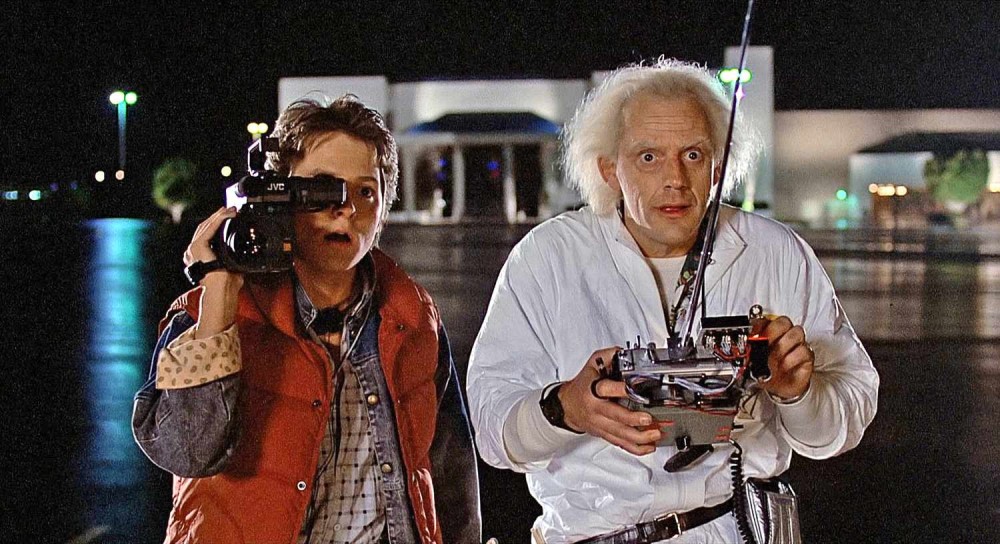
Writing over at ILM.com, I look back at the visual effects of Back to the Future, as well as sitting down to chat with the films legendary cinematographer Dean Cundey (Jurassic Park, Romancing the Stone, Apollo 13) who described not only the enduring charm and kegend of the film, but also his working relationship with BTTF director Robert Zemeckis.
Budget and technology led to a number of alterations, but good old-fashioned spitballing brought one of the film’s most memorable concepts to life: the DeLorean ripping through time at 88 miles per hour as it leapt forward or backward in time. ILM animation supervisor Wes Takahashi and his team were handed the task of bringing this concept to life on celluloid. With Zemeckis, the ILM crew explored multiple iterations of a so-called “time slice” created by the vehicle.
“No one can describe what they want in a shot like Bob Zemeckis can,” Ralston told Cinefex.
“He wanted something really powerful – everything in the show had to be very fast and very violent. The way he put it was: ‘Time travel is not pretty.’”Speaking recently with ILM.com, Dean Cundey agrees with what Ralston said 40 years ago. “Bob Zemeckis was very much a visual storyteller, who was open to suggestions and embellishments on how to implement the vision he had for a scene.”
Cundey explains the cinematographer’s place in the creation of a scene. “I’ve always looked at the cinematographer as the bridge between the technical stuff and telling the story. Typically, the director is at the forefront of storytelling and the emotion that the audience sees and experiences, and the cinematographer is the one who implements that vision using cameras, lights, and so forth. Those two sides have to blend in the middle for the audience to experience the movie. Sometimes the director will rely on the cinematographer for inspiration; how wide is the shot, should the camera move, that kind of stuff.”
That ease of collaboration between director and cinematographer, a partnership that would continue throughout the Back to the Future trilogy, was a creative gold mine that freed up both Zemeckis and Cundey to bring their very best work to the show. “I think Bob realized that I was very much interested in the storytelling as opposed to ‘What’s a cool way to light this shot?’ I’ve always been interested in immersing the audience in the scene as opposed to just creating a striking image.