



Written by the always engaging Jamie Benning over at ILM.com, check out this fascinating article looking at the visual effects of The Mandalorian and Grogu with VFX legend John Knoll, looking at how digital innovations sat alongside handcrafted models and classic techniques to deliver an IMAX extravaganza.
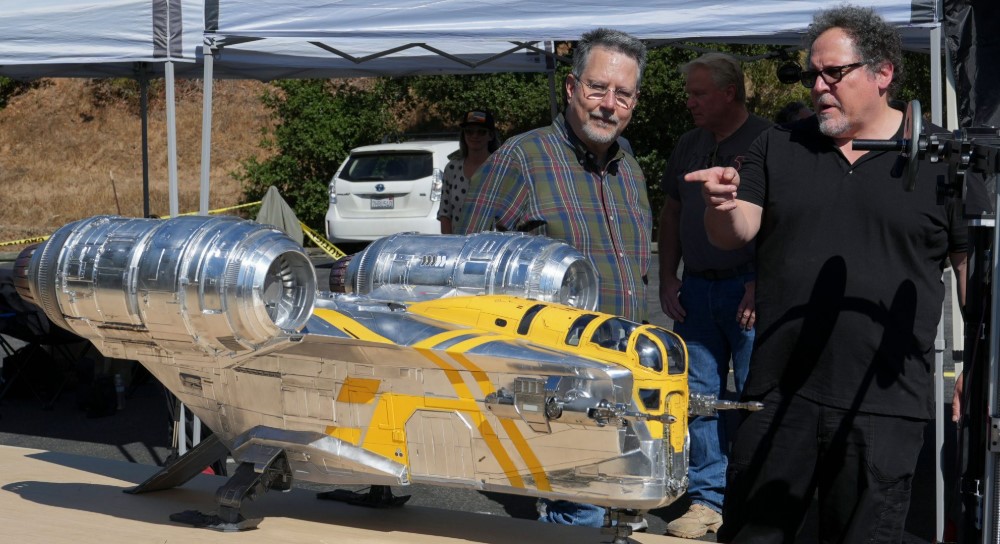
If one philosophy unifies the effects work on The Mandalorian and Grogu, it’s that no technique is inherently better than any other, only more or less appropriate for the job at hand. “We’re pretty comfortable with any technique,” Knoll says, “from the oldest of the old all the way to the newest, latest buzzwords in computer graphics.”
In practice, that means the film draws on a remarkable range of methods developed by ILM and other departments across the production: rubber-mask and animatronic creatures, stop-motion animation, motion-control miniatures, LED volume work, photogrammetry, fully synthetic CG characters, and a technique deployed in recent years at ILM, Gaussian Splatting. What unifies them is not the technology but the intention: Each approach was chosen because it was the right tool, and each was inflected by the visual style the series established over five seasons.
Knoll is emphatic that this wasn’t nostalgia for its own sake. The Mandalorian series production team built up what he describes as a “legacy style book,” a set of visual and craft values that audiences have come to associate with it, and abandoning that in pursuit of a slicker, more uniformly digital look would have been a betrayal of something real. The handmade quality of the work, the sense that physical things exist in physical space, is part of what gives the world its texture and weight.