

Journey through the entire Dark Horse Star Wars comics run, one series at a time and in chronological, in-universe order. Between 1991 and 2014, Dark Horse Comics produced over forty individual Star Wars comic series, helping to shape what fans now call Legends, expanding the universe beyond the films. From the birth of the Jedi 25,000 years before the films to the far-future Legacy era, we will chronicle one of the most ambitious Expanded Universe projects in Star Wars history.
Era: Dawn of the Jedi
Series: Dawn of the Jedi: Force Storm
Behind the scenes
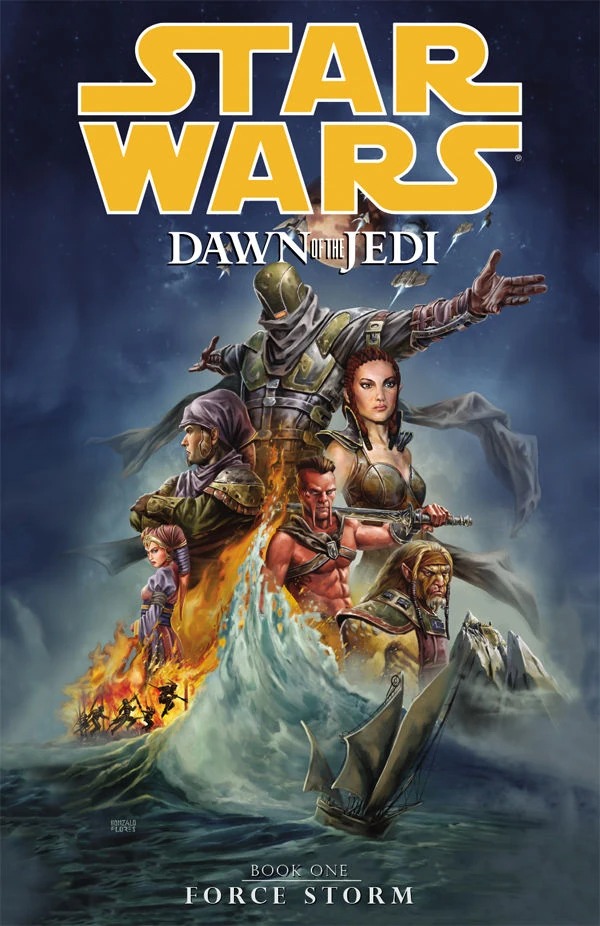 When Dawn of the Jedi: Force Storm launched in 2012, Dark Horse had already explored thousands of years of galactic history through Tales of the Jedi, Knights of the Old Republic, and Legacy. The ancient Sith Wars had been mapped, the Republic had risen and fallen, and the Skywalker bloodline had stretched into the far future — but the true beginning remained unexplored.
Bringing back long-time collaborators John Ostrander and Jan Duursema, the series was commissioned as an ambitious arc of myth-building. Rather than filling in gaps, it aimed to define the philosophical foundation of the saga itself. It connected earlier Legends ideas — the Rakata, the ancient Force Wars — while subtly reframing how we think about the origins of the Jedi. Though later reclassified as Legends, its influence can still be felt in modern storytelling, such as the reintroduction of Tython in The Mandalorian, and the film reportedly in development with filmmaker James Mangold, set in this ancient era.
Summary
Set around 25,000 BBY, Dawn of the Jedi: Force Storm takes place at the very beginning of recorded Force history. In this distant era the Force was studied through an ancient tradition known as the Dai Bendu. Long before the Jedi Order, pyramid-shaped vessels called the Tho Yor gathered Force-sensitive individuals from across the galaxy and carried them to the Deep Core planet Tython, where the earliest Force tradition — the Je’daii Order — would emerge.
Over generations the Je’daii established temples across the Tython system, studying the Force through a philosophy of balance between Ashla and Bogan. But the Tho Yor migrations also brought non–Force-sensitive settlers, later known as the Children of the Je’daii, whose communities grew alongside the temples. Tensions between these populations eventually erupted into the Despot War, when the Twi’lek warlord Queen Hadiya of Shikaakwa attempted to unite rival factions and overthrow Je’daii authority on Tython. Though she was ultimately defeated, the conflict left lasting scars across the system.
Beyond the Deep Core, however, another power had begun searching the galaxy for worlds strong in the Force. The Rakata Infinite Empire, an ancient civilisation that used Force-sensitive slaves known as Force Hounds to locate such worlds, eventually turned its attention toward Tython. One of those slaves, Xesh, is sent by his Rakatan masters to find the planet.
When Xesh reaches the system aboard a Rakatan warship, the violent clash of dark side energies unleashes a catastrophic disturbance known as a Force Storm, pulling several vessels out of hyperspace and stranding them in orbit around Tython. Captured by the Je’daii, Xesh becomes the first clear evidence that powerful forces exist beyond their isolated world.
As the Je’daii struggle to contain the crisis, the arrival of outsiders and the threat of the Rakata begin to expose deeper divisions within the Order itself. At 25,000 BBY, the beliefs that will one day shape the Jedi are not yet doctrine — they are still being debated.
Thared’s thoughts
 I still remember the excitement of seeing Dawn of the Jedi unveiled as an official era during the Lucasfilm Studio Showcase at Star Wars Celebration Europe in 2023 with my brother Theo — a reminder that these stories, even as Legends, continue to shape the galaxy far, far away….
If I’m honest, Dawn of the Jedi isn’t an era I ever particularly wanted to see explored. Part of the magic of Star Wars, for me at least, has always been the sense that some things belong to myth — that the origins of the Jedi are better left slightly mysterious. That said, I did enjoy this series. It feels appropriately ancient and uncertain, a time when the language and traditions surrounding the Force haven’t yet settled into the doctrines we later recognise.
One detail I particularly enjoyed was the use of the term “Bendu,” which first appeared in the rough draft of the script for A New Hope as the name of the Jedi Knights, the “Jedi-Bendu.” Seeing it reappear here as part of the ancient vocabulary of the Force is a lovely piece of connective tissue between the earliest ideas of Star Wars and the stories that came decades later.
The Tho Yor are another fascinating element. The idea of mysterious pyramid-shaped vessels travelling the galaxy and gathering Force-sensitive individuals is wonderfully mythic, although I found myself wishing we had been given a little more explanation about them — who built them, why they chose their symbol, and what their ultimate purpose might have been. The imagery itself is striking, and their emblem in particular feels deliberate and symbolic in ways that invite speculation.
The Force Hounds also stood out to me. Their ability to track Force-sensitives immediately reminded me of the Inquisitors introduced later in modern canon. Whether intentional or coincidental, it’s interesting to see similar ideas appear in different corners of the Star Wars universe — another example of how themes tend to echo across generations of storytelling.
My Star Wars Story
One of my earliest and happiest memories is walking into Toys “R” Us in 1996 and seeing an entire aisle of Star Wars! I was six years old. I remember being given the choice between one Power of the Force figure or two Bend-Ems — I chose Luke Skywalker and Darth Vader, because they both had lightsabers! That evening, we rented A New Hope from Blockbuster. I didn’t really have a ‘thing’ before Star Wars — but from that night on, I did.
Growing up, we didn’t have much. I didn’t own many figures, but my mum always made sure I had the latest Dark Horse comic. Those comics became my Star Wars. I would read and re-read them, rearranging them in timeline order, fascinated by how even the most minor alien or background character had a story to tell. The galaxy felt alive — not just because of the films, but because of everything happening around them.
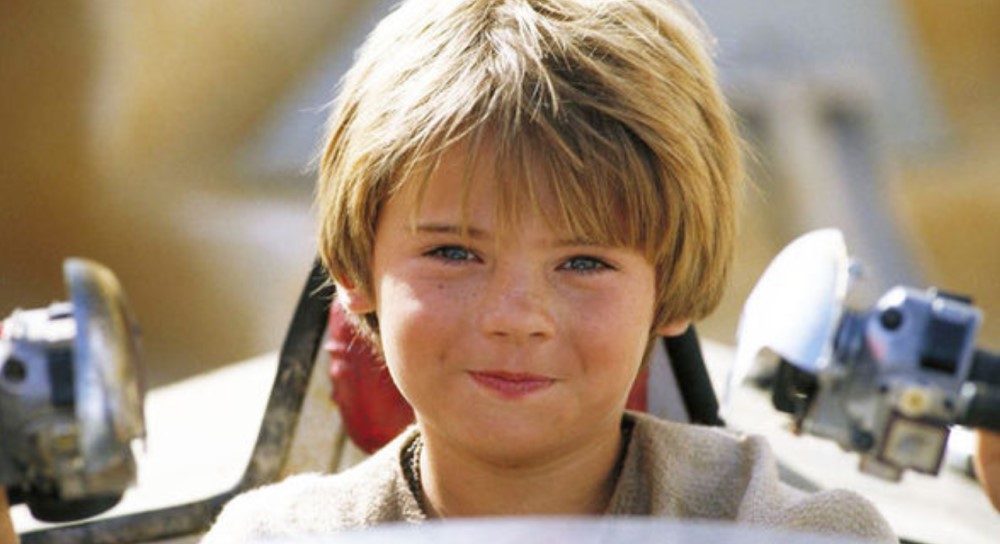
When The Phantom Menace was announced, I genuinely felt like it was being made for me. Anakin was my age. He even looked a bit like me. The idea that Darth Vader — the most terrifying villain in the galaxy — had once been a child blew my mind. That perspective has stayed with me ever since.
Years later, when my little brother Theo was born, ‘my thing’ became ‘our thing’. We watched The Clone Wars, played Battlefront and Knights of the Old Republic, and worked our way through the comics together. When I moved out after getting married, I wanted to chase my childhood dream — to be a small part of the Star Wars universe, and to share it with my brother.
I reached out to Corinna Bechko, writer of Star Wars: Legacy Volume II, and asked if she would ever consider naming a minor character after a combination of our names — Jared and Theo. To my amazement, she replied that she would love to give us a cameo. Unfortunately, our email reached her on the very same day she learned that Marvel would be taking over the Star Wars license and that the series would be cut short and wrapped up in just 18 issues. It felt like the opportunity had slipped away before it had even begun.
Then another message arrived. She hadn’t forgotten about us.
In issue #18 — the final Dark Horse Star Wars comic, and the furthest point in the original Expanded Universe timeline — “Thared” appeared as an Imperial Knight. The kindest thing anyone has ever done for me. We even got to meet Corinna at a comic book signing in London and have remained friends ever since.
Years later, the character was even acknowledged in Star Wars Insider #202, which mentioned that Thared had been named after me and Theo — giving my Star Wars story an official source and immortalising my childhood dream.
Star Wars has never just been films for me. It’s escapism. It’s history. It’s legacy. It’s the Dark Horse comics, the Legends timeline, and the stories that expanded the galaxy far beyond the films. My son is named Ezra (middle name Bridger), I have Legacy Volume II tattooed on my arm, both pieces of original art from Thared’s appearances framed, and I am known by everyone I know for being Star Wars mad. I am so proud that Thared is my legacy. This blog is my way of returning to those stories — one series at a time — and giving them the attention they deserve.
Jared ‘Thared’ Peppard
Remember to check out our literature podcast Canon Fodder over at Fantha Tracks Radio and TV, part of the Friday Night Rotation.