



Journey through the entire Dark Horse Star Wars comics run, one series at a time and in chronological, in-universe order. Between 1991 and 2014, Dark Horse Comics produced over forty individual Star Wars comic series, helping to shape what fans now call Legends, expanding the universe beyond the films. From the birth of the Jedi 25,000 years before the films to the far-future Legacy era, we will chronicle one of the most ambitious Expanded Universe projects in Star Wars history.
Era: Dawn of the Jedi
Series: Dawn of the Jedi: Prisoner of Bogan
Behind the scenes
Following the release of Dawn of the Jedi: Force Storm, Dark Horse quickly expanded the series with Prisoner of Bogan in 2012, continuing John Ostrander and Jan Duursema’s exploration of the earliest days of Force history. While Force Storm focused heavily on introducing Tython, the Je’daii, and the wider mythology surrounding the Tho Yor and the Rakata, Prisoner of Bogan shifts the emphasis toward character and ideology — particularly through the growing importance of Xesh.
The series takes its name from Bogan, the dark moon of the Tython system associated with imbalance and the dark side of the Force. In doing so, it begins drawing clearer thematic lines between the Je’daii philosophy of balance and the more recognisable Jedi and Sith beliefs that would emerge thousands of years later. Although the Je’daii Order still rejects absolute concepts of light and dark, the story increasingly questions whether true balance can realistically exist once fear, attachment, and conflict begin influencing individuals.
Summary
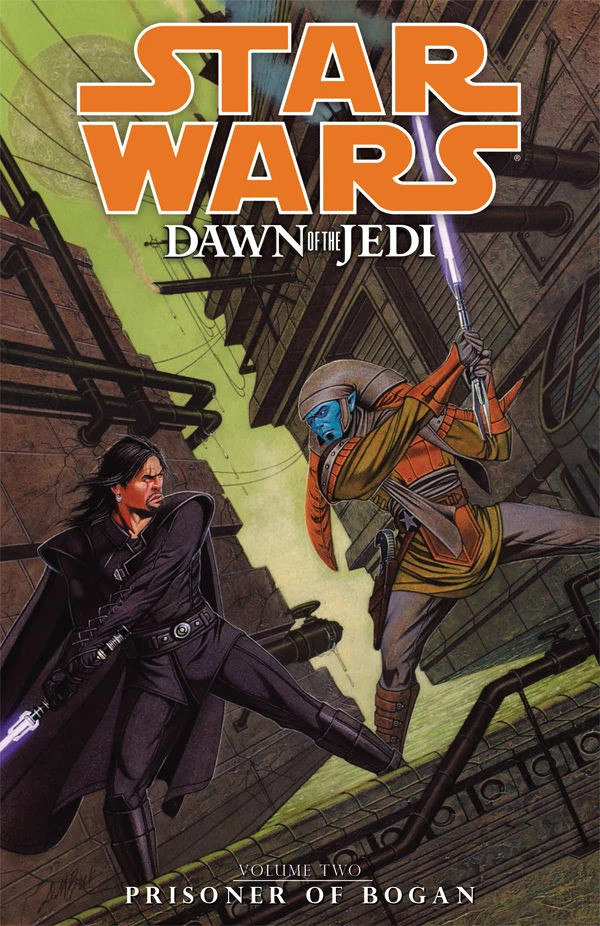 Set shortly after the events of Force Storm around 25,000 BBY, Dawn of the Jedi: Prisoner of Bogan follows the growing instability spreading across Tython after the arrival of Xesh and the revelation that powerful Force-sensitive civilizations exist beyond the Je’daii’s isolated system. Captured during the Force Storm crisis, Xesh is brought before the Je’daii Council, where the Order remains divided over whether he should be studied, imprisoned, or executed. While some Je’daii believe he represents an opportunity to understand the wider galaxy, others see him as a dangerous servant of the dark side corrupted by the influence of the Rakata Infinite Empire.
As tensions rise, Xesh is eventually exiled to Bogan — one of Tython’s moons traditionally used to isolate those believed to be dangerously unbalanced in the Force. There he encounters the fallen Je’daii Daegen Lok, whose followers reject the Je’daii philosophy of balance altogether. It is also on Bogan that Xesh begins forming a deeper connection with Shae Koda, whose compassion and curiosity expose him to ideas completely foreign to Rakatan society — choice, individuality, and emotional connection. Cut off from both the Je’daii and the Rakata, Xesh gradually begins questioning his loyalty and the violent purpose he was created to serve, while his fellow Force Hound broodmate Trill attempts to track him through the lingering connection they share.
The series also further explores the aftermath of the Despot War and the political scars left behind by Queen Hadiya of Shikaakwa’s failed uprising against the Je’daii. Former followers and generals loyal to Hadiya continue operating across Tython, while revelations emerge surrounding Daegen Lok, whose Force visions had once driven him toward rebellion. It is also revealed that Volnos Ryo, father of Je’daii Ranger Hawk Ryo and leader of a criminal syndicate, secretly manipulated Daegen Lok into assassinating Queen Hadiya in order to destabilise the conflict for his own gain.
Meanwhile, the Rakata Infinite Empire continues searching for Tython, viewing its Force-sensitive population as a valuable resource to exploit. Rather than presenting a simple battle between good and evil, Prisoner of Bogan explores imbalance and identity during an era when the concepts of Jedi and Sith have not yet fully formed, with the Je’daii beginning to realise that maintaining balance may be far more difficult than they once believed.
Thared’s thoughts
One thing that continues to stand out to me throughout Dawn of the Jedi is just how naturally John Ostrander and Jan Duursema work together as a creative team. Having already collaborated on series like Legacy and Republic, there is a familiarity to the pacing and storytelling that makes these comics very easy to read despite the amount of mythology and world-building involved. That said, while I appreciate the ambition of this era, it still does not feel quite as mystical to me as Tales of the Jedi, nor quite as enjoyable as Knights of the Old Republic, which I think benefited from being more character-driven and less reliant on establishing an entirely new corner of the galaxy. I do really like the concept of Tython being balanced between the moons of Ashla and Bogan, but something that slightly throws me off is that this era is presented as the “beginning” of Jedi history while simultaneously referring to things that already feel ancient. Throughout the series we hear about earlier conflicts, see ancient architecture, ruins, monuments, and even relics like an “ancient holocron”, creating a strange feeling that even at the dawn of the Jedi, we are still arriving long after history has already begun.
I also enjoyed seeing the lingering consequences of the Despot War, particularly through the surviving generals who once served Queen Hadiya of Shikaakwa. Another aspect I found interesting was Volnos Ryo, whose character feels familiar to the galaxy far, far away — operating as the head of a criminal syndicate while simultaneously being married to a Je’daii Ranger. The reveal that he secretly arranged the assassination of Queen Hadiya through Daegen Lok adds another layer to the political instability surrounding Tython after the Despot War and helps reinforce the idea that corruption, ambition, and manipulation have always existed within galactic history, even this early on.
Perhaps the most significant lore addition in the series, though, is the origin of the Force sabers. I think the most interesting insight comes when Xesh mentions that “every Force Hound must build his own” — a tradition that would later be carried on by the Jedi themselves. Seeing the origins of the most iconic weapon in Star Wars history helps make the era feel meaningfully connected to the wider mythology of the franchise.
What I do find particularly interesting about the Dawn of the Jedi era is that, unlike a lot of Legends, it still feels relatively untouched by modern canon. Outside of references like Tython appearing in The Mandalorian, this corner of the timeline has largely been left alone and could easily be revisited one day without too much contradiction.
Article by Jared ‘Thared’ Peppard.