


Journey through the entire Dark Horse Star Wars comics run, one series at a time and in chronological, in-universe order. Between 1991 and 2014, Dark Horse Comics produced over forty individual Star Wars comic series, helping to shape what fans now call Legends, expanding the universe beyond the films. From the birth of the Jedi 25,000 years before the films to the far-future Legacy era, we will chronicle one of the most ambitious Expanded Universe projects in Star Wars history.
Era: Dawn of the Jedi
Series: Dawn of the Jedi: Force War
Behind the scenes
When Dawn of the Jedi: Force War launched in 2013, it concluded John Ostrander and Jan Duursema’s exploration of the earliest era in Star Wars history. Across three series, the creative team had charted the origins of the Je’daii Order, the philosophy of balance on Tython, and the arrival of the Rakata Infinite Empire thousands of years before the Republic and Jedi Order.
Having previously collaborated on Republic and Legacy, Ostrander and Duursema examined a period when the concepts of Jedi and Sith had not yet fully formed, forcing the Je’daii to question whether balance could survive in the face of invasion and war. Released shortly before Marvel regained the Star Wars comic licence, Force War would become the final story set in the Dawn of the Jedi era. Although now part of Legends, the era remains largely untouched by modern canon outside of references to Tython, leaving many of its ideas open to future reinterpretation.
Summary:
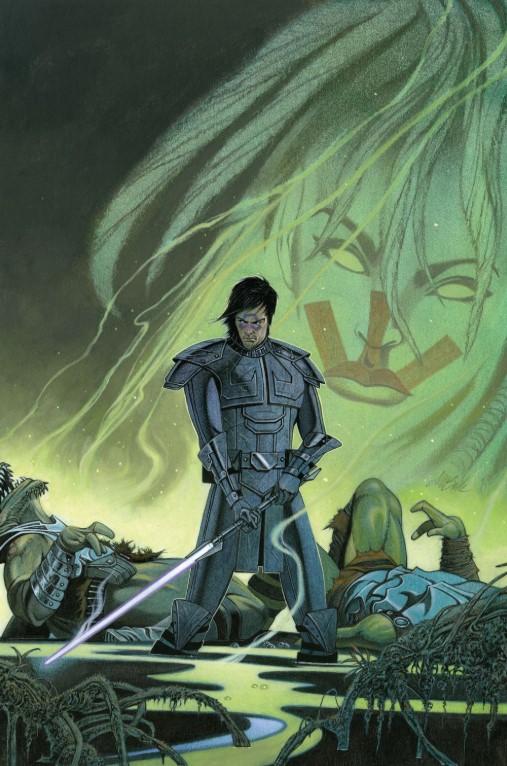 Set shortly after the events of Prisoner of Bogan, Dawn of the Jedi: Force War sees the conflict between the Je’daii Order and the Rakata Infinite Empire finally erupt into open war. Having escaped Tython, Xesh returns to his Rakatan masters, where he finds himself torn between his loyalty to the Infinite Empire and the new emotions and relationships he experienced among the Je’daii.
Meanwhile, Daegen Lok continues gathering followers on Bogan, exploiting fear and uncertainty within the Tython system. His claims that the Je’daii have lost their way gain support among those who believe the traditional philosophy of balance has failed to protect the system from outside threats.
As the Rakata launch their assault on Tython, Predor Skal’nas seeks to exploit the Force-sensitive population of the system and bring the Je’daii under Rakatan control. The invasion forces the Je’daii to abandon many of their long-held beliefs, as warriors, Rangers, and Temple Masters unite against an enemy unlike any they have previously encountered.
The war also places enormous strain upon Xesh, whose connection to Shae Koda continues to grow even as his fellow Force Hound broodmate Trill attempts to return him to the service of the Rakata. Caught between two worlds, Xesh ultimately becomes a symbol of the larger conflict between domination and balance.
During the fighting, the Je’daii begin moving away from their traditional dependence upon Tython’s moons of Ashla and Bogan to regulate emotional imbalance. The realities of war demonstrate that balance cannot simply be imposed through exile, but must instead be achieved internally — a philosophical shift that would eventually influence the future Jedi Order.
The conflict culminates in the defeat of the Rakatan invasion and the fall of several key figures on both sides. Although Tython survives, the Je’daii emerge changed by the experience, having discovered that their philosophy of balance is far more fragile than they once believed.
Rather than concluding the origins of the Jedi, Force War leaves many questions unanswered. At 25,000 BBY, the Force remains mysterious, the Je’daii are still evolving, and the foundations of the Jedi and Sith are only just beginning to take shape
Thared’s thoughts:
Although the Dawn of the Jedi era still is not my favourite period of Star Wars history, I did enjoy seeing what is effectively the first Jedi war. The Je’daii are forced to abandon the comfort of Tython’s balance philosophy and confront the reality that conflict, fear, and the dark side cannot simply be exiled to another moon. Even so, part of me still prefers the mystery that existed before these stories. Prior to Dawn of the Jedi, the origins of the Jedi felt almost mythical, particularly in Tales of the Jedi and I am not entirely convinced that every question needed answering.
That said, John Ostrander and Jan Duursema remain one of my favourite creative partnerships in Star Wars. Between Republic, Legacy, and Dawn of the Jedi, they have shaped a large part of what I consider my own Star Wars ‘head canon’. Their characters, storytelling, and understanding of the Expanded Universe consistently make these stories feel connected, even when separated by thousands of years.
One aspect of Force War that particularly interested me was the ancient holocron discovered by Xesh. For an era supposedly taking place at the very beginning of Jedi history, it is fascinating that knowledge and relics already exist that are considered ancient. The holocron itself feels like a direct link to the wider Star Wars mythology, reminding us that even at 25,000 BBY there are still forgotten histories and lost civilisations that predate the Je’daii.
I also found the Sith species Je’daii who embrace the dark side particularly interesting. Seeing members of the red-skinned Sith species serving within the Je’daii Order before ultimately giving themselves to Bogan and darker emotions feels like an early reflection of the Jedi and Sith conflict that would later define galactic history. Although the Sith Order does not yet exist, the seeds of that division are already present.
The trilogy begins with balance and ultimately ends with conflict, almost foreshadowing the entire history of the Jedi Order itself. The Je’daii learn that balance is far more difficult to maintain than they believed, while war begins pushing them toward the more familiar Jedi philosophy that would emerge thousands of years later.
What I continue to find most interesting about the Dawn of the Jedi era is how untouched it remains by modern canon. Outside of Tython itself, very little has been revisited, leaving the door open for many of these ideas to eventually return. Of all the Legends eras, this may be the easiest to reinterpret for a modern audience, and I would be surprised if we do not see elements of it explored during the Disney era.
Bonus – “Many of the Truths We Cling To….”:
For decades, Star Wars fans have invested not only money, but time and hope into the galaxy far, far away. We collect the comics, read the novels, listen to the audiobooks, and follow interconnected stories across multiple formats because we trust in thatjourney.
The disappearance of the High Republic audiobooks from Audible UK (the world’s largest audiobook provider), leaving collections incomplete; the discontinuation of Insider (The Official Magazine); previously canon stories, such as parts of the Ahsoka novel, being superseded by other media; lost momentum due to delays for series such as Ahsoka; inconclusive arcs for the characters in Solo and the introduction of Plagueis in The Acolyte; not to mention the announced and then cancelled films….
None of these examples are catastrophic on their own. Licensing changes. Ideas change. Delays happen. The concern is the cumulative effect. Should we start a collection in fear that the media may be discontinued or rendered non-canon — especially in the age of streaming, where content can be removed or altered at any time? This is not a criticism of Disney or Lucasfilm. If anything, it is a reflection of how much fans care.
We invest because we love these stories and want to be a part of the journey. We want to know that the stories we invest in today will still matter tomorrow.
Article by Jared ‘Thared’ Peppard.