



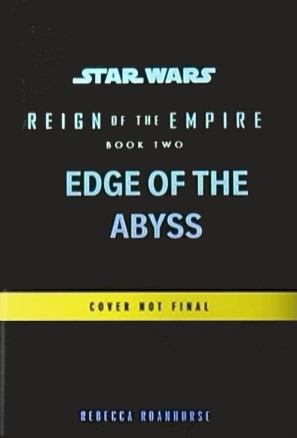
Star Wars: Reign of the Empire – Edge of the Abyss
Over a decade into the Empire’s reign, life under imperial rule has become routine. The days of the Republic have long passed into memory – if they are remembered at all.
Within the Senate, Mon Mothma and Bail Organa face dwindling influence, for there is no difference between the will of the Emperor and the direction of his Empire. Bail increasingly shifts his focus to support clandestine resistance efforts, knowing a successful fight against the Empire will come from beyond the halls of power. Meanwhile, Mon Mothma sees once chance to take a stand when she makes a horrifying discover about the lengths the regime will go to weaponize truth and loyalty. The Empire’s newest target: the next generation raised under the Emperor’s deepening shadow, including Mon and Bail’s daughters.
Across the galaxy, disparate rebel factions are rendered outcasts, branded criminals, and pitted against each other. On Ghorman, an idealistic student group seeks to make meaningful change, unaware of the ISB agent who seeks to sabotage them from the inside. Leaders like Saw Gerrera and Anto Kreegyr squabble and bargain to survive one more day against the crush of Imperial might. Trust is rare and betrayal quick. A distracted, disorganised resistance is one that is easy to snuff out.
There are few heroes…and no alliances.
When one of Gerrera’s partisans is captured by the Empire, time is running out for senators, outcastes, spies, and all those that desire a better tomorrow. What the prisoner knows could held the Empire eradicate any whisper of resistance, end any rebellion before it can truly begin – and ensure that the Empire’s truth is all the galaxy will ever know.
Author: Rebecca Roanhorse
Cover artist: Marko Manev
Editor: Tom Hoeler
Release Date: 15th September 2026
Page Count: 336 pages
ISBN: 9781529945515
The next Star Wars novel picks up the Reign of the Empire trilogy with a taut and thrilling new story. Let’s talk more about why it’s worth picking up!
Alexander Freed’s incredible The Mask of Fear kicked off Star Wars’ Reign of the Empire trilogy on a high note. Offering political intrigue thrills and thematic depth that kept readers dwelling on things long after the final page was turned; it perfectly scratched that Andor itch with some of the deeper lore and bigger action.
It was easily one of my favorite novels of last year. As such, I’ve been very much looking forward to this next book in the trilogy, Edge of the Abyss. Especially as it was bringing in Rebecca Roanhorse, who wrote the excellent Resistance Reborn novel, on board to write it. It was a longer wait than I’d hoped for, but ultimately worth it in the end.
Edge of the Abyss picks up Bail, Mon Mothma, and Saw Guerrera’s fight against the ever-growing oppression of the Empire over a decade following the events of the first novel. It actually takes place one year before the events of the first Andor season, so quite a bit of time has passed. The Empire’s hold on the galaxy is less tenuous and the fight against them is more desperate.
As in the previous novel, the primary focus of the story is centered on the main trio of Mon, Bail, and Saw. When one of Saw’s attacks goes South and a member of his team is captured, it threatens to expose the work they’ve managed to accomplish throughout their loose alliance. While Bail and Saw immediately set out to cover their tracks (in their own ways), Mon contends with a threat that hits a little closer to home.
In an effort to extend their influence and control, the Empire has set their sights on the next generation of galactic denizens. Enlisting the—grudging—aid of a popular singer, Quanaliko, they’re using pop culture and subliminal messaging to sway younger kids to their viewpoint. Mon’s daughter Leida is caught up in the fervor and looking to mark her birthday with a special concert.
Chemish Runazha also makes a return in a bit more prominent role, having disregarded their mentor’s advice and becoming a full-on spy for the ISB. Their current assignment has them infiltrating a university on Ghorman (yes, that Ghorman) where they’re tracking a student-led anti-Imperial group. By this point, they’re damn good at their job, but as they dive deeper into this task doubts about their work for the Empire begin to deepen.
They’re faced with something of an identity crisis as they find themselves personally invested in Fennro Drogan, the man who’s supposed to get her in contact with the leaders of the student activist group. But when Anto Kreeygr (who’s out to make his mark and prove himself a revolutionary like Saw) steps into the picture, offering the kids a chance to strike back at the Empire, Chemish’s mission becomes even more complicated.
There is so much more going on in this book I haven’t really touched on. From Nankry’s capture, to the importance of her Barrister (an attorney) who has an unexpected connection to Saw Guerrera, some really great moments with younger Leia, and even some other Andor characters who pop up. But in the effort to avoid spoilers, I’ll leave it vague. Suffice it to say, the majority of these plot threads come together in some interesting ways, with outcomes I wasn’t fully expecting.
It’s impressive to see how the new characters mesh so seamlessly with those who’re already well established. It’s a credit to Roanhorse’s character work that these newcomers (or those who only had minor roles before) feel just as deep and engaging as those we’ve journeyed with previously. As such, the story strikes an impressive balance between the familiar and fresh that keeps things thoroughly interesting.
I think it’s important to note, Abyss is definitely a different kind of novel than Mask of Fear. Honestly, when they announced the trilogy would be written by multiple authors, I had some concerns. Freed’s writing style is certainly unique and carries an intensity that’s difficult to emulate.
Thankfully, Edge of the Abyss skirts this concern completely by thoroughly being its own thing. It’s best to go into this novel thinking of it more of a follow-up to Mask of Fear rather than a sequel…if that makes sense? While it utilizes the same characters and picks up on some previous arcs/plot threads, it’s not at all a direct continuation of the story. Nor does it even really feel like the middle-book of a trilogy.
In many ways, it feels like a standalone book. I’d happily argue that someone who skipped The Mask of Fear (don’t do that, it’s amazing) would be able to dive into this novel without feeling lost. Roanhorse does a phenomenal job of establishing these characters in this particular time it almost feels as if we’re engaging with them for the first time; you don’t need all the backstory in order to understand their mindset and the arcs they go through. For those who’ve read the first book, you can see the toll the years under the Empire has taken and how it’s shaped their current outlook/actions.
It’s a great approach that not only makes this a readily accessible book for everyone, but makes it easy for fans to dive into without feeling like they need a refresher on what came before. After all, it’s been over a year since The Mask of Fear launched and several Star Wars stories have hit since then. Even if you’ve forgotten some of the details, Roanhorse’s dynamic prose and fleshed out characters won’t leave you falling behind.
In this way, Abyss manages to feel enough like its own thing that I didn’t find myself constantly comparing it to The Mask of Fear. Both novels set out to do different things, tell different stories, and work all the better because the authors bring their unique voices to them. While they have similar threads and mesh together, there isn’t a competition between them. This allowed me to appreciate this new novel for its own merits and enjoy it without the lofty expectations already set at the beginning of this trilogy.
Where the previous novel put the emphasis on the Empire’s initial blitz tactics to assert control (and how these characters try to deal with it), Abyss puts us firmly within the Empire’s period of dominance. And yet, even more than a decade later, we’re shown the lengths they must go to in order to stay in control. The cracks are beginning to show and it’s clear their control is far from absolute.
The book explores this in some subtle—and not so subtle—ways. The big one is how their propaganda arm is working to insert themselves into popular culture. Beyond the more obvious things like altering historical texts/lessons in schools, using celebrities to nudge impressionable minds to a certain way of thinking is a terrifying level of devious. And yet, it shows how much fascist regimes NEED to control every little aspect of life in order to remain in charge.
Then there’s Chemish. They’ve been working undercover, inserting themselves into various activist groups to expose “anti-Imperial sentiments” for well over a decade. The fact they constantly have new jobs/missions indicates how widespread, and not centralized, these rebellious ideas are. It makes for a nice tie-in to Nemik’s manifesto in Andor, giving proof to his words that “It occurs spontaneously and without instruction. Random acts of insurrection are occurring constantly throughout the galaxy.”
One of the things that impressed me most—something I didn’t even pick up on until towards the end—is how the structure/pacing is intentionally in line with the novel’s overarching thematic elements. While many of the plot threads ultimately come together in some loose way, there’s a disparate feel to the various character arcs and threads being woven.
There were numerous points throughout my read where POV jumps between characters—even whole plot points—felt random. Like they didn’t really intersect and that multiple stories were being told instead of leading to something more cohesive. This was especially the case when you consider some characters appear for only a chapter or two, without much explanation. Not to mention some of the abrupt, shocking ways plot threads were resolved within the story.
I can’t deny it bugged me a little bit. Even as the novel retained a quick pace I couldn’t put down, I couldn’t shake this disjointed feeling. As Edge of the Abyss entered the final stretch, however, and plot elements began resolving, the purpose clicked for me: it’s meant to mimic the state of the “rebellion” at this point in time.
There’s no real organization, or even solid communication, between the many disgruntled citizens. Instead, they’re just a bunch of different people who want to do good but can’t quite figure out what that means. While they share similar goals, the ever-pervasive fear and oppression of the Empire keeps them in a near constant state of paranoia.
This makes it almost impossible for them to work together. Instead, even as they work towards a common end, they wind up at cross purposes and tripping over each other. While they accomplish certain things in the end, the results are messy. They’re left scrambling to carve out some form of win rather than celebrating a decisive victory against the Empire.
By structuring the story this way, readers are thrust into the heart of this tumultuous alliance. I keenly felt the stress while watching these characters nearly sabotage one another. To the point I found myself angry they simply wouldn’t communicate/work together. Not only does it expertly capture this chaotic time for the rebellion, it puts a spotlight on one of the more unseen/insidious ways the Empire remains in control.
This revelation threw the entire novel into a new light for me. I found myself looking back on certain aspects of the story and appreciating them differently. It added to certain character moments and gave more immediacy to some of the action beats. Ultimately, I came to understand the many layers put into the novel that makes it work on multiple levels. It left me with a lot to dwell on and I can already sense how the story will feel different when it’s time to revisit it.
This is even more impressive considering how quick the story moves. Let me put it this way…The Mask of Fear is like a political thriller TV series; featuring plot and characters that continually build and build until the finale. Edge of the Abyss, meanwhile, is more like a political thriller movie; kicking things off at a certain level and it doesn’t relent until the final chapter.
One final thing I feel the need to mention, and speaks to me on a more personal level. There are a number of themes, aside from the more obvious/prevalent, explored in this book. One that’s a bit more subtle, is how it discusses identity and how such circumstances can impact a person’s sense of self.
Even for stalwart characters like Saw, who’s commitment to the fight never wavers, we can see how the years of fighting, and hard decisions, have turned him into someone more haunted. Mon Mothma struggles to balance the idea of being a public figure who’s fighting back along with being a parent and spouse. Bail’s moral compass remains as firm as ever, but we can see the shift from words to more overt action and the need to get things done.
Anto’s heart is in the right place for sure, but his desperate need to prove himself as a “real” rebel causes more problems. Karama must contend with the violent person she was and the person she wants to be. All of these characters have some interesting journeys that show the multifaceted nature that resides in us all and the strength of character one needs to do what’s right.
For me, however, Chemish’s arc stood out the most. I won’t go much into detail here to keep avoiding spoilers, but I was enthralled by her identity crisis. They spend so much time pretending to be someone they’re not, following the orders of a system they don’t fully believe in (but are compelled to follow), they’ve practically forgotten the person they were before. The type of conviction that ultimately led them onto this path in the first place.
It’s a little hard to explain without direct examples, but Chemish’s story spoke to me as a Native American. I’m not sure Roanhorse developed this aspect with that in mind, but knowing she also shares an indigenous background, I wouldn’t be surprised to find it was intentional.
So far, Reign of the Empire is two for two in its trilogy. Edge of the Abyss manages to break free of the lofty expectations set by the first novel and delivers a middle chapter that stands on its own. Between engaging characters, a thrilling story that keeps the pages turning, and a level of depth that’ll keep your mind pondering it long after you’ve closed the book, there’s absolutely no reason to pass up on this one.