



The Lucas Museum of Narrative Art is up and running, bringing visitors in from across the US and the rest of the world, and here we have news of two things to focus on when you visit. First, showing in the museum’s Robert Flaherty Theater you can watch Seeing Is Believing, as Oxford historian Janina Ramirez guides you through the power of visual storytelling.
Step into the story of us. 🌍✨ Seeing Is Believing takes viewers on an epic journey across continents and centuries, exploring how humans have used art to tell stories, share ideas, and shape cultures throughout history. Guided by Oxford historian Janina Ramirez, this film project reveals the power of visual storytelling and why narrative art remains at the heart of what makes us human.
Commissioned by George Lucas and the Lucas Museum of Narrative Art. Episodes screening daily in the Robert Flaherty Theater at The Lucas Museum.
The museum also shines a spotlight on Maxfield Parrish, the artist known as the ‘master of light’, who’s skill at capturing light was so captivating, General Electric commissioned him to create a series of lightbulb advertisements back in the 1920’s. His works can be viewed in the Parrish Gallery at the LMNA.
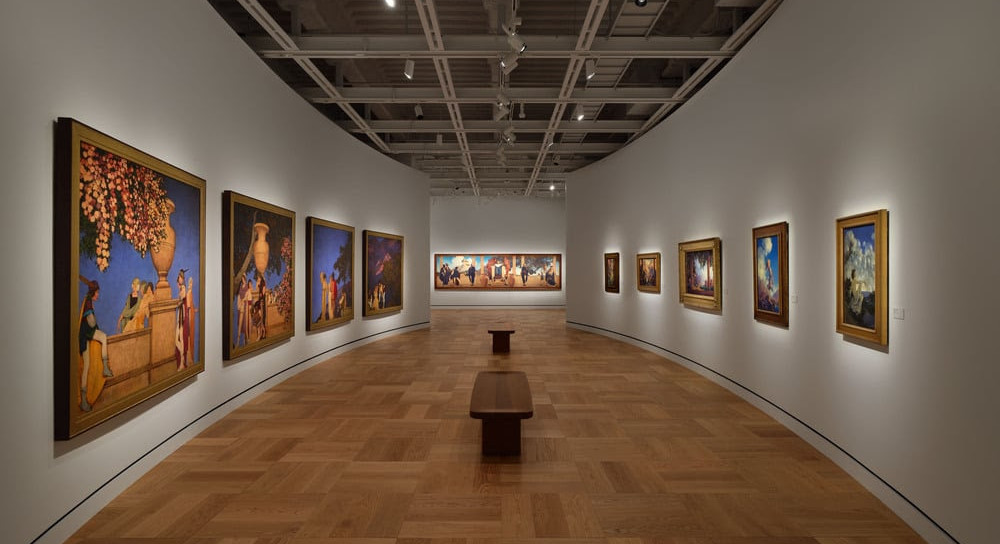
Maxfield Parrish’s Illuminated Worlds
There’s a reason that Maxfield Parrish is called the “master of light.” The way the sun’s golden light cuts across the landscapes in his paintings is so brilliant you really have to see it in person to experience it.And it’s no secret that the Lucas Museum’s Parrish gallery, with its curved walls and peaceful atmosphere, is a favorite for many visitors and staff members. “This gallery is designed to be a kind of sanctuary,” says Ryan Linkof, Senior Curator and Head of Film Programs at the Lucas Museum. “It has an immediately calming effect.”
The worlds of Parrish fit somewhere between reality and dreams. He recognized that color shows its most striking qualities when light shines through it—like in a stained-glass window—and managed to recreate the effect through precise, membrane-thin layers of oil paint and varnish. These transparent layers reflect light back to the viewer, making the painting look lit up from within.Ecstasy, illustration for Edison Mazda calendar, Maxfield Parrish, 1930.
Parrish became so famous for capturing light that General Electric commissioned him to create a series of lightbulb advertisements, including the 1929 painting Ecstasy, currently on display in our Parrish gallery. It shows a figure (modeled on Parrish’s own daughter) meeting the glowing sun with a pose of pure joy.
As Rafael Navarro, a comic book artist in our collection, told us recently, “Parrish’s paintings are a celebration of life.” It’s hard not to leave the Parrish gallery a little brighter.