


Gaming Review: Star Wars: Galactic Racer

- Advertisement -
- Advertisement -

Star Wars: Galactic Racer

Star Wars: Galactic Racer is a high-stakes reinvention of racing born in the lawless Outer Rim of the Star Wars galaxy.

The Empire’s grip on the galaxy has finally broken, and with its fall comes a new obsession: speed. As the New Republic struggles to rebuild, gambling, entertainment, and glory fuel a booming underground.

Out of this chaos, the Galactic League is born: an unsanctioned racing circuit where syndicates sponsor pilots, fortunes are won and lost in seconds, and only the bold survive.

No Force. No prophecy. Just skill, strategy, and the will to rise.

Platforms: PC, PlayStation 5, Xbox Series X|S
Developer: Fuse Games
Publisher: Secret Mode
Release date: 6 October 2026

Star Wars: Galactic Racer has a wonderfully unheroic central question: can you keep a temperamental machine in one piece long enough to earn another race? There are no lightsabers to rescue a bad braking point, no Force push for the rival who has just occupied your line and no prophecy promising that the next corner will go better. There is only speed, metal, heat and the uncomfortable knowledge that the wall is getting larger very quickly.

That narrow focus is exactly what makes Fuse Games’ racer work. Galactic Racer is set in the uneasy years after the Empire, when the Galactic League has turned the Outer Rim into an unsanctioned travelling motorsport circus. You play as Shade, an ambitious racer trying to climb through a competition financed by people who appear to consider safety regulations a personal insult. Fantha Tracks’ pre-release coverage had already picked up on the game’s aggressive handling and physicality, but the finished game reveals a much stranger structure beneath the obvious racing fantasy.

This is not simply a modern attempt to repeat the podracing years. It is a racing game built around repeated campaign runs, vehicle builds, rivalries, risky route choices and four classes of repulsorcraft that demand different instincts. The result occasionally fights with itself, but when its systems line up, Galactic Racer feels like a corner of Star Wars that should have existed long ago.
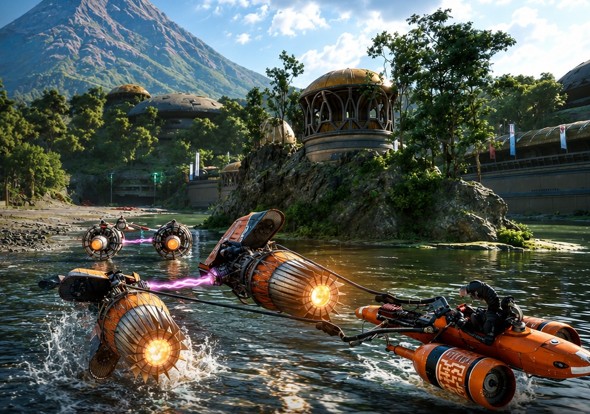
Galactic Racer treats Star Wars machinery as the centre of the fantasy rather than background decoration. Image: Fuse Games / Lucasfilm Games.

Speed only matters when the machine has a personality

The first success is the handling. Galactic Racer is generous enough to let a new player enjoy the sensation of throwing a machine through a sweeping turn, but it is not so forgiving that every vehicle becomes the same hover-car with a different bonnet. Landspeeders carry their weight into corners and are comfortable being bullied into a drift. Speeder bikes feel exposed and impatient. Skim speeders reward a more flowing approach, while podracers eventually take the speed dial to the point where confidence and evidence begin to disagree.

That distinction matters because the game is at its best when a vehicle changes how you think before the corner arrives. A heavy machine can survive contact that would ruin a more delicate run. A nimble class can take a line that simply is not there for something wider. Boost and heat create another layer of judgement, particularly once upgrades begin encouraging bad habits. The fast choice is not automatically the correct choice, which is a healthy rule for any racing game and an almost revolutionary idea in a galaxy where most pilots appear to regard throttle control as a moral weakness.

The physical side is also where the Criterion heritage is easiest to feel. Rivals lean on you, takedowns can become part of the race rather than a separate combat system, and a clean lap can collapse into improvised damage control in a few seconds. Fantha Tracks previously highlighted footage that looked like ‘complete carnage’; that description remains useful, but the important part is that the chaos usually has a readable cause. When a race goes wrong, you can normally identify the decision that started the problem.
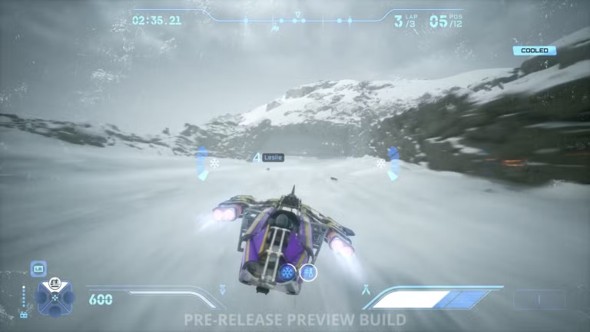
Cold-weather racing makes speed only one part of the problem. Image: pre-release Galactic Racer gameplay footage.

The campaign gives every race a memory

The more unusual idea sits outside the cockpit. Galactic Racer does not arrange its main campaign as a simple ladder of fixed cups. Tours branch. Events offer different rewards. Parts and upgrades change the current machine, and a run gradually develops its own personality depending on which opportunities you chase and which risks you survive. That means the tenth race in a campaign is not just race number ten. It is the next test for a vehicle that has been shaped by the previous nine decisions.

This structure is the game’s best answer to repetition. A circuit may be familiar, but your current build can make it behave differently. A setup that produces absurd acceleration may tempt you to attack every straight and then expose a weakness in tighter sections. A tougher build invites contact. A heat-focused machine can make environmental temperature suddenly relevant. The campaign keeps asking small questions about what you want the vehicle to become, and those answers are immediately tested at racing speed rather than left sitting in a garage menu.

For players who want to dig into the mechanics beyond the review, the complete Star Wars: Galactic Racer guide at Star Wars: Gaming breaks down the campaign structure, vehicle classes, upgrades, planetary hazards and other systems in much more detail. The useful point here is simpler: the buildcraft does not replace the racing. It changes the reasons you take risks once the race begins.
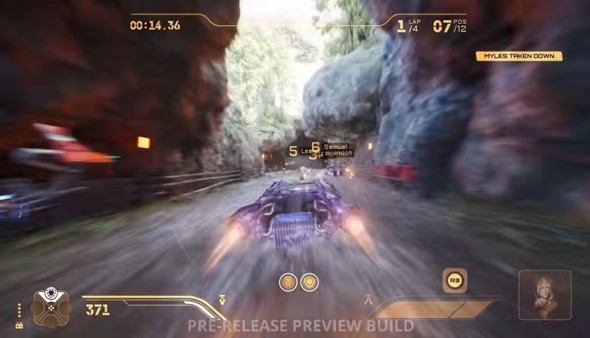
Build choices and route knowledge matter most when the track gives the machine very little time to think. Image: pre-release Galactic Racer gameplay footage.

The Galactic League feels like a place, not a menu

Galactic Racer also spends more time on its world than a racing game strictly needs. Shade has rivals, mechanics and relationships around the League, while the paddock gives the campaign a physical space between events. That can slow the pace when all you want is another start line, but it also stops the championship from becoming a row of event icons floating in space. The League develops the atmosphere of a travelling sport with grudges, reputations, machinery and people who have all made questionable career choices for reasons that gradually become understandable.

This is one of the smartest ways the game uses Star Wars. It does not need to keep producing famous faces to prove that the licence is present. The worn machinery, alien competitors, cluttered workshops and slightly criminal organisation of the whole enterprise do that work more naturally. The galaxy feels lived in because the characters are interested in racing, repair bills and each other, not because someone has paused the conversation to explain where they were during the Battle of Endor.

The audio supports that identity as well. Engines have enough character to make a vehicle class recognisable before you study the HUD, while the score understands when to step forward and when the noise of the race should carry the scene. Fantha Tracks has followed the sound and voice work around the Galactic League before release, and in the finished game that material helps sell the idea that this is a sport with its own culture rather than a collection of Star Wars tracks linked by menus.

The planets are more useful when they are trying to kill you

The strongest environments are the ones that interfere with driving rather than merely providing a new skybox. Ando Prime’s cold conditions can turn temperature into part of vehicle management. Lantaana’s mixture of jungle, water and volcanic heat makes the route itself part of the mechanical conversation. Fantha Tracks’ earlier look at Lantaana focused on the planet’s tropical setting and active volcano; in the full game, that sort of environmental identity is most effective when it changes how aggressively you can use the machine.

Visually, Galactic Racer is often excellent. Imperial wreckage becomes track furniture, frozen tunnels compress the racing line, toxic industrial landscapes are properly hostile and the faster classes make large environments feel alarmingly small. The problem is not lack of spectacle. It is that several tracks sharing one world can begin to blur together after a long session. The game has strong planets, but not every individual circuit earns the same memory. A few more unmistakable corners, landmarks or signature hazards would have given the track list stronger fingerprints.

That weakness becomes more obvious because the campaign encourages repeated runs. Familiarity is useful in a racing game, but there is a line between learning a circuit and feeling that a planet has started recycling its sentences. Galactic Racer crosses that line occasionally, especially when a run keeps you in one visual family for too long.
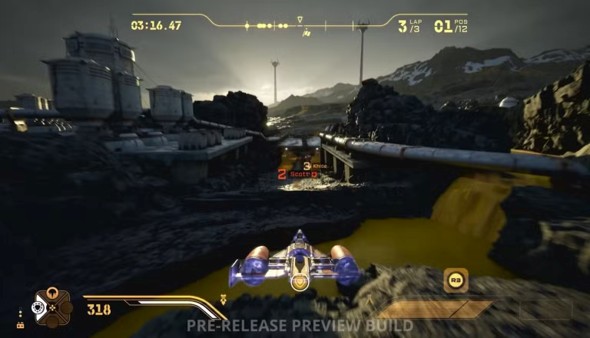
Industrial and hostile environments give Galactic Racer some of its strongest visual identity. Image: pre-release Galactic Racer gameplay footage.

Its ambition creates the rough edges

The campaign’s biggest problem is that the narrative and the run structure do not always want the same thing at the same time. A story benefits from carefully timed escalation. A runs-based game benefits from repetition, divergence and the possibility that the player arrives somewhere in a different condition than expected. Galactic Racer tries to preserve both, which means character moments can sometimes feel oddly placed around the rhythm of failure and restart.

The paddock has a similar problem. I like that it exists. I like that mechanics, rivals and the League have somewhere to stand that is not a statistics screen. But there are moments when walking to the next conversation feels like being asked to obey a pedestrian crossing immediately after surviving several hundred kilometres per hour. The friction is minor, yet it is one of the places where the game’s enthusiasm for worldbuilding interrupts the very thing it does best.

None of this damages the racing core. It simply exposes how many ideas Fuse has attempted to fit around it. A more conventional game would probably have been smoother. It would also have been much less interesting.

A Star Wars racing game with its own reason to exist

The most important achievement is that Galactic Racer does not spend its whole life looking backwards. Podracing matters, and the connection to Episode I: Racer is impossible to ignore, but Fuse has resisted making nostalgia the organising principle. The Galactic League includes landspeeders, bikes, skim craft and pods because Star Wars has forty-nine years of ridiculous transportation to draw from. The game finally treats that mechanical history as a sporting culture rather than a museum shelf.

That is why it feels convincingly Star Wars even when nobody is holding a lightsaber. The fiction is carried by engineering, sound, silhouettes, improvised repairs, old war debris and people trying to make a living in the gaps left by larger events. The official launch material highlighted by Fantha Tracks presents Galactic Racer as a high-stakes reinvention of racing, and that phrase is more accurate than it first appears: the game is not only reviving one famous sequence from The Phantom Menace. It is asking what organised racing might look like across the rest of the galaxy.

The answer is messy, loud and occasionally overdesigned, but it has a point of view. That is more valuable than perfect polish.

Verdict

Star Wars: Galactic Racer succeeds because the actual act of racing is strong enough to support everything built around it. The vehicle classes are meaningfully different, contact has consequences, upgrades alter behaviour instead of merely decorating a stat sheet and the campaign gives failed attempts enough context to make another run tempting rather than exhausting. The League itself is surprisingly likeable too, especially once the machinery, characters and rivalries begin to feel connected.

Its weaker pieces are easy to identify. Some circuits on the same planet lack a strong individual identity, the paddock can interrupt momentum and the story occasionally has to squeeze itself around a campaign structure that was designed to be repeated rather than perfectly paced. Those are real flaws. They are also the sort of flaws produced by a game trying to build something larger than a collection of races.

After such a long absence for dedicated Star Wars racing, the safest option would have been a polished act of remembrance. Fuse Games chose something riskier. Galactic Racer takes the old fantasy of impossible speed and builds an entire underground sport around it. Not every component fits cleanly, but the machine runs, it has personality and, most importantly, finishing one Tour still leaves you thinking about what you would change before the next one. For a racing game, that is a very good reason to keep the engine warm.

About the author

Søren Ahrensborg Kamper has written about Star Wars games, their history and the communities around them since 2009. He is the editor of Star Wars: Gaming, where he covers new releases, game history and the strange decisions that become much more reasonable once somebody adds a hyperdrive.

Guest Contributor
Guest Contributor
Guest articles by contributors from across the galaxy.
- Advertisement -
- Advertisement -

Star Wars: Galactic Racer

Star Wars: Galactic Racer is a high-stakes reinvention of racing born in the lawless Outer Rim of the Star Wars galaxy.

The Empire’s grip on the galaxy has finally broken, and with its fall comes a new obsession: speed. As the New Republic struggles to rebuild, gambling, entertainment, and glory fuel a booming underground.

Out of this chaos, the Galactic League is born: an unsanctioned racing circuit where syndicates sponsor pilots, fortunes are won and lost in seconds, and only the bold survive.

No Force. No prophecy. Just skill, strategy, and the will to rise.

Platforms: PC, PlayStation 5, Xbox Series X|S
Developer: Fuse Games
Publisher: Secret Mode
Release date: 6 October 2026

Star Wars: Galactic Racer has a wonderfully unheroic central question: can you keep a temperamental machine in one piece long enough to earn another race? There are no lightsabers to rescue a bad braking point, no Force push for the rival who has just occupied your line and no prophecy promising that the next corner will go better. There is only speed, metal, heat and the uncomfortable knowledge that the wall is getting larger very quickly.

That narrow focus is exactly what makes Fuse Games’ racer work. Galactic Racer is set in the uneasy years after the Empire, when the Galactic League has turned the Outer Rim into an unsanctioned travelling motorsport circus. You play as Shade, an ambitious racer trying to climb through a competition financed by people who appear to consider safety regulations a personal insult. Fantha Tracks’ pre-release coverage had already picked up on the game’s aggressive handling and physicality, but the finished game reveals a much stranger structure beneath the obvious racing fantasy.

This is not simply a modern attempt to repeat the podracing years. It is a racing game built around repeated campaign runs, vehicle builds, rivalries, risky route choices and four classes of repulsorcraft that demand different instincts. The result occasionally fights with itself, but when its systems line up, Galactic Racer feels like a corner of Star Wars that should have existed long ago.

Galactic Racer treats Star Wars machinery as the centre of the fantasy rather than background decoration. Image: Fuse Games / Lucasfilm Games.

Speed only matters when the machine has a personality

The first success is the handling. Galactic Racer is generous enough to let a new player enjoy the sensation of throwing a machine through a sweeping turn, but it is not so forgiving that every vehicle becomes the same hover-car with a different bonnet. Landspeeders carry their weight into corners and are comfortable being bullied into a drift. Speeder bikes feel exposed and impatient. Skim speeders reward a more flowing approach, while podracers eventually take the speed dial to the point where confidence and evidence begin to disagree.

That distinction matters because the game is at its best when a vehicle changes how you think before the corner arrives. A heavy machine can survive contact that would ruin a more delicate run. A nimble class can take a line that simply is not there for something wider. Boost and heat create another layer of judgement, particularly once upgrades begin encouraging bad habits. The fast choice is not automatically the correct choice, which is a healthy rule for any racing game and an almost revolutionary idea in a galaxy where most pilots appear to regard throttle control as a moral weakness.

The physical side is also where the Criterion heritage is easiest to feel. Rivals lean on you, takedowns can become part of the race rather than a separate combat system, and a clean lap can collapse into improvised damage control in a few seconds. Fantha Tracks previously highlighted footage that looked like ‘complete carnage’; that description remains useful, but the important part is that the chaos usually has a readable cause. When a race goes wrong, you can normally identify the decision that started the problem.

Cold-weather racing makes speed only one part of the problem. Image: pre-release Galactic Racer gameplay footage.

The campaign gives every race a memory

The more unusual idea sits outside the cockpit. Galactic Racer does not arrange its main campaign as a simple ladder of fixed cups. Tours branch. Events offer different rewards. Parts and upgrades change the current machine, and a run gradually develops its own personality depending on which opportunities you chase and which risks you survive. That means the tenth race in a campaign is not just race number ten. It is the next test for a vehicle that has been shaped by the previous nine decisions.

This structure is the game’s best answer to repetition. A circuit may be familiar, but your current build can make it behave differently. A setup that produces absurd acceleration may tempt you to attack every straight and then expose a weakness in tighter sections. A tougher build invites contact. A heat-focused machine can make environmental temperature suddenly relevant. The campaign keeps asking small questions about what you want the vehicle to become, and those answers are immediately tested at racing speed rather than left sitting in a garage menu.

For players who want to dig into the mechanics beyond the review, the complete Star Wars: Galactic Racer guide at Star Wars: Gaming breaks down the campaign structure, vehicle classes, upgrades, planetary hazards and other systems in much more detail. The useful point here is simpler: the buildcraft does not replace the racing. It changes the reasons you take risks once the race begins.

Build choices and route knowledge matter most when the track gives the machine very little time to think. Image: pre-release Galactic Racer gameplay footage.

The Galactic League feels like a place, not a menu

Galactic Racer also spends more time on its world than a racing game strictly needs. Shade has rivals, mechanics and relationships around the League, while the paddock gives the campaign a physical space between events. That can slow the pace when all you want is another start line, but it also stops the championship from becoming a row of event icons floating in space. The League develops the atmosphere of a travelling sport with grudges, reputations, machinery and people who have all made questionable career choices for reasons that gradually become understandable.

This is one of the smartest ways the game uses Star Wars. It does not need to keep producing famous faces to prove that the licence is present. The worn machinery, alien competitors, cluttered workshops and slightly criminal organisation of the whole enterprise do that work more naturally. The galaxy feels lived in because the characters are interested in racing, repair bills and each other, not because someone has paused the conversation to explain where they were during the Battle of Endor.

The audio supports that identity as well. Engines have enough character to make a vehicle class recognisable before you study the HUD, while the score understands when to step forward and when the noise of the race should carry the scene. Fantha Tracks has followed the sound and voice work around the Galactic League before release, and in the finished game that material helps sell the idea that this is a sport with its own culture rather than a collection of Star Wars tracks linked by menus.

The planets are more useful when they are trying to kill you

The strongest environments are the ones that interfere with driving rather than merely providing a new skybox. Ando Prime’s cold conditions can turn temperature into part of vehicle management. Lantaana’s mixture of jungle, water and volcanic heat makes the route itself part of the mechanical conversation. Fantha Tracks’ earlier look at Lantaana focused on the planet’s tropical setting and active volcano; in the full game, that sort of environmental identity is most effective when it changes how aggressively you can use the machine.

Visually, Galactic Racer is often excellent. Imperial wreckage becomes track furniture, frozen tunnels compress the racing line, toxic industrial landscapes are properly hostile and the faster classes make large environments feel alarmingly small. The problem is not lack of spectacle. It is that several tracks sharing one world can begin to blur together after a long session. The game has strong planets, but not every individual circuit earns the same memory. A few more unmistakable corners, landmarks or signature hazards would have given the track list stronger fingerprints.

That weakness becomes more obvious because the campaign encourages repeated runs. Familiarity is useful in a racing game, but there is a line between learning a circuit and feeling that a planet has started recycling its sentences. Galactic Racer crosses that line occasionally, especially when a run keeps you in one visual family for too long.

Industrial and hostile environments give Galactic Racer some of its strongest visual identity. Image: pre-release Galactic Racer gameplay footage.

Its ambition creates the rough edges

The campaign’s biggest problem is that the narrative and the run structure do not always want the same thing at the same time. A story benefits from carefully timed escalation. A runs-based game benefits from repetition, divergence and the possibility that the player arrives somewhere in a different condition than expected. Galactic Racer tries to preserve both, which means character moments can sometimes feel oddly placed around the rhythm of failure and restart.

The paddock has a similar problem. I like that it exists. I like that mechanics, rivals and the League have somewhere to stand that is not a statistics screen. But there are moments when walking to the next conversation feels like being asked to obey a pedestrian crossing immediately after surviving several hundred kilometres per hour. The friction is minor, yet it is one of the places where the game’s enthusiasm for worldbuilding interrupts the very thing it does best.

None of this damages the racing core. It simply exposes how many ideas Fuse has attempted to fit around it. A more conventional game would probably have been smoother. It would also have been much less interesting.

A Star Wars racing game with its own reason to exist

The most important achievement is that Galactic Racer does not spend its whole life looking backwards. Podracing matters, and the connection to Episode I: Racer is impossible to ignore, but Fuse has resisted making nostalgia the organising principle. The Galactic League includes landspeeders, bikes, skim craft and pods because Star Wars has forty-nine years of ridiculous transportation to draw from. The game finally treats that mechanical history as a sporting culture rather than a museum shelf.

That is why it feels convincingly Star Wars even when nobody is holding a lightsaber. The fiction is carried by engineering, sound, silhouettes, improvised repairs, old war debris and people trying to make a living in the gaps left by larger events. The official launch material highlighted by Fantha Tracks presents Galactic Racer as a high-stakes reinvention of racing, and that phrase is more accurate than it first appears: the game is not only reviving one famous sequence from The Phantom Menace. It is asking what organised racing might look like across the rest of the galaxy.

The answer is messy, loud and occasionally overdesigned, but it has a point of view. That is more valuable than perfect polish.

Verdict

Star Wars: Galactic Racer succeeds because the actual act of racing is strong enough to support everything built around it. The vehicle classes are meaningfully different, contact has consequences, upgrades alter behaviour instead of merely decorating a stat sheet and the campaign gives failed attempts enough context to make another run tempting rather than exhausting. The League itself is surprisingly likeable too, especially once the machinery, characters and rivalries begin to feel connected.

Its weaker pieces are easy to identify. Some circuits on the same planet lack a strong individual identity, the paddock can interrupt momentum and the story occasionally has to squeeze itself around a campaign structure that was designed to be repeated rather than perfectly paced. Those are real flaws. They are also the sort of flaws produced by a game trying to build something larger than a collection of races.

After such a long absence for dedicated Star Wars racing, the safest option would have been a polished act of remembrance. Fuse Games chose something riskier. Galactic Racer takes the old fantasy of impossible speed and builds an entire underground sport around it. Not every component fits cleanly, but the machine runs, it has personality and, most importantly, finishing one Tour still leaves you thinking about what you would change before the next one. For a racing game, that is a very good reason to keep the engine warm.

About the author

Søren Ahrensborg Kamper has written about Star Wars games, their history and the communities around them since 2009. He is the editor of Star Wars: Gaming, where he covers new releases, game history and the strange decisions that become much more reasonable once somebody adds a hyperdrive.

Guest Contributor
Guest Contributor
Guest articles by contributors from across the galaxy.
- Advertisement -
- Advertisement -
- Advertisement -