


Gaming Review: Star Wars: Zero Company (Full game review)

- Advertisement -
- Advertisement -

Star Wars: Zero Company

Star Wars Zero Company’s visual storytelling and gameplay will immerse players in a tense, clandestine conflict taking place in the shadows of the Clone Wars. Players will step into the shoes of former Galactic Republic officer Hawks and current leader of Zero Company. Zero Company is an unconventional outfit of professionals for hire hailing from across the galaxy, including a Clone Trooper, a Mandalorian of the ancient Clan Verminoth, a Jedi Padawan and more. Together, Zero Company must hunt down and stop Kundri Fathom, leader of the Separatist-aligned cult, the Infinite Coil.

From Zero Company’s base of operations, The Den, players will recruit and progress skills of Operators, upgrade facilities, purchase new equipment and select their next mission from the holotable. On the battlefield, players will develop bonds between authored characters and player-created Operators, unlocking new support abilities, including cross-training benefits that improve their abilities and stats. Players will navigate an ever-changing galaxy map featuring more than 150 planets where each choice can change how their journey unfolds.

In Star Wars Zero Company customization is central to the experience. Hawks and recruited Operators can be created from eight iconic Star Warsspecies: Devaronian, Human, Neimoidian, Ovissian, Togruta, Twi’lek, Weequay and Zabrak. Voices, outfits and many other aspects of Hawks and an Operator’s appearance can be customized along with specializations and talents over time. It’s up to players to unite their Operators and form the best squad for the mission at hand.

Platforms: PC, PlayStation 5, Xbox Series X|S
Publisher: Electronic Arts
Developer: Bit Reactor
Release Date: 27 August 2026

There is a moment in Star Wars: Zero Company when a plan that looked immaculate on the holotable begins to disintegrate in public. One Operator is pinned behind bad cover, another has spent the Action Point you were quietly relying on, and a B1 battle droid that should have been dead two turns ago is still standing there with the sort of confidence usually reserved for people who have not read the mission briefing.

That is when Zero Company works best.

For more than a year, the easy description has been “Star Wars XCOM.” It is accurate enough to be useful and reductive enough to become irritating. Fantha Tracks was already reporting that the game was impressing ahead of release, and the later gameplay trailer made the influences impossible to miss: percentage shots, cover, flanking, turn economy, injuries and a squad that can become considerably less cheerful if you make poor decisions. After spending serious time with the finished game, however, the important thing is not how much Bit Reactor borrowed. It is how comfortably those systems fit Star Wars.

The Clone Wars turns out to be almost indecently well suited to a tactics game.
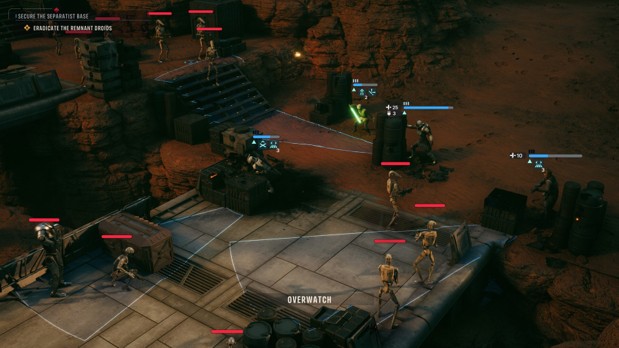
A Zero Company mission turns the battlefield into a puzzle of cover, positioning and overlapping abilities. Image: EA / Bit Reactor.

A war in the shadows of the Clone Wars

You play as Hawks, a former Republic officer now leading Zero Company, a collection of mercenaries, soldiers, specialists and droids whose careers have generally taken an interesting turn. Republic Intelligence pulls the company into a conflict with the Infinite Coil, a Separatist-aligned cult led by Kundri Fathom, and what begins as another dangerous contract becomes something much larger.

The premise is strongest when it keeps its boots dirty. The Clone Wars has already been told from the perspective of generals, Jedi and politicians. Zero Company is interested in the people working several floors below history, where a war looks less like a sweeping galactic tragedy and more like ammunition, injuries, debts and a bad corridor full of droids.

That approach was visible in Fantha Tracks’ coverage of the final trailer, but the finished game gives the idea room to breathe. Familiar characters and locations appear, yet Bit Reactor resists making every scene depend on somebody the audience already recognises. Hawks and the squad feel as though they occupy their own corner of the galaxy.

The story itself is solid rather than extraordinary. Kundri Fathom and the Infinite Coil provide a suitably sinister threat, and the campaign has several strong character moments, but the central plot sometimes functions mainly as a reason to put Zero Company on another transport. The squad carries the emotional weight far more effectively than the villains do.
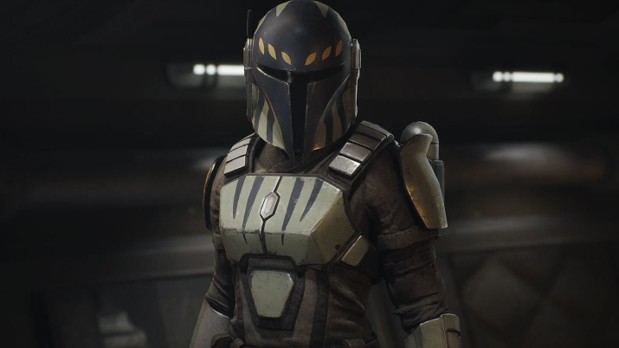
The authored Operators give Zero Company a stronger identity than its familiar tactical framework initially suggests. Image: EA / Bit Reactor.

Combat is where Zero Company earns its name

The tactical layer is excellent. Each Operator has a pool of Action Points that can be spent on movement, attacks, abilities and utilities, and the apparent simplicity quickly opens into a satisfying network of possibilities. The tactical gameplay breakdown covered the fundamentals before launch, but the pleasure comes from discovering how much can happen inside those basic rules.

You can knock an enemy out of cover and into another Operator’s Overwatch cone. You can spend shared Advantage on powerful abilities without touching normal AP. You can use assists to turn one attack into several. You can build a character around efficient kills, defensive retaliation, critical hits, mobility or healing, then discover that another Operator makes the entire idea work twice as well.

The best turns feel less like issuing four separate orders and more like winding up a machine.
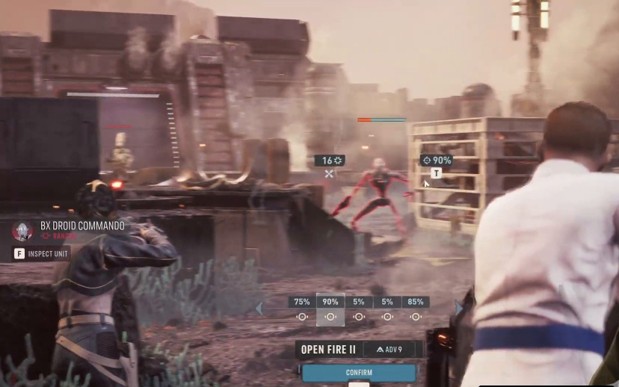
Chance-to-hit, positioning and Action Point economy make even a simple blaster shot part of a larger tactical sequence. Image: EA / Bit Reactor.

It also helps that Zero Company removes some traditional XCOM friction. The battlefield is readable, and the game generally gives you enough information to understand why a shot is good, why a position is dangerous and where the enemy pressure is coming from. You spend less time creeping forward in fear of accidentally discovering half the Separatist army behind a crate and more time solving the problem already in front of you.

That clarity does not make the game easy. Poor positioning still hurts, injuries can follow an Operator back to base, and mistakes compound quickly when the squad begins a mission with the wrong tools. On harder settings, the difference between “aggressive” and “administratively regrettable” can be one exposed flank.

What keeps the system fresh is the freedom to change how the squad works. Specializations can be adjusted, equipment matters, and Operators often become valuable for reasons that are not obvious from their first few missions. A broader Star Wars Zero Company guide hub becomes useful once the game starts layering Bonds, build choices, mission economy and facility upgrades on top of the basic firefights.
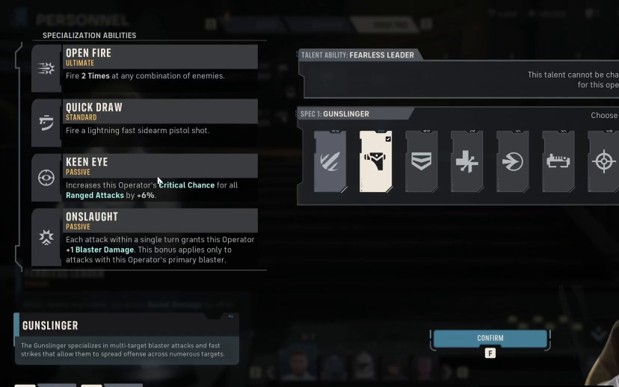
Specializations and talents let Operators move well beyond their starting battlefield roles. Image: EA / Bit Reactor.

The Den makes the squad matter

Between missions, Zero Company returns to The Den, and this is where Bit Reactor makes one of its smartest decisions. Instead of treating the strategic layer as a spreadsheet with dramatic music, the game gives you a physical base where you can walk around, speak to people, manage facilities and prepare for the next operation.

Bonds deepen that idea. Operators who work together can develop relationships that unlock useful synergies, so squad composition becomes both a mechanical and emotional decision. You might bring two characters because their abilities complement each other, then keep bringing them because the game has quietly convinced you that they belong together.
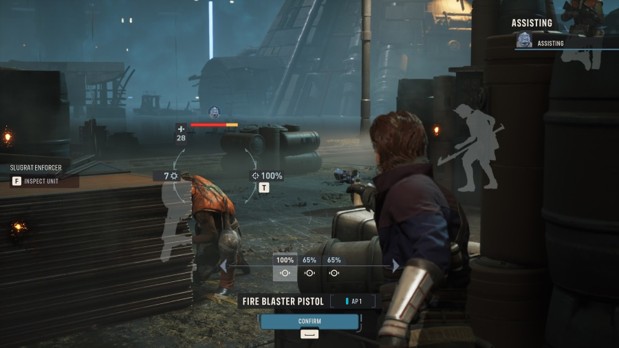
Assists and squad synergies turn individual actions into coordinated attacks. Image: EA / Bit Reactor.

Permadeath can be enabled or disabled, which is sensible given how authored many of these characters are. With it active, however, the campaign acquires a nastier edge. Losing somebody whose conversations you have been following, whose Bonds you have developed and whose build has become central to the company changes how you look at a bad turn.

The wider campaign layer is busy without becoming exhausting. Missions compete for attention, Intel and Credits matter, the galaxy map shifts, and facility upgrades create useful long-term decisions. Running a mercenary company, it turns out, contains rather more administration than the posters suggested.
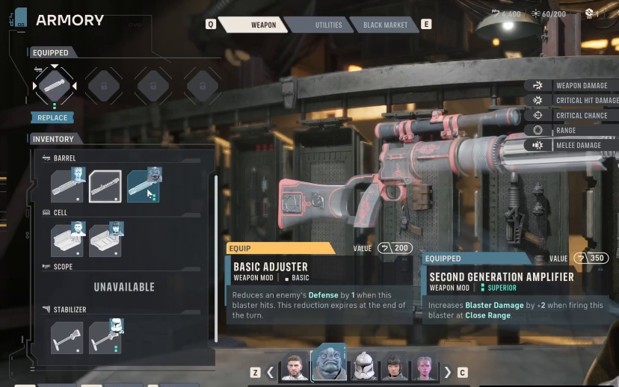
The Den’s facilities, equipment and upgrades ensure that victory is not decided only on the battlefield. Image: EA / Bit Reactor

A game that sounds like Star Wars

Presentation is another major strength. Zero Company is not merely a tactics game wearing licensed armour. The camera dives down for attacks, explosions have weight, blaster fire looks properly dangerous and each Operator has enough animation personality to stop the battlefield becoming a collection of chess pieces.

Gordy Haab’s soundtrack does a great deal of quiet work as well. Fantha Tracks highlighted the score when it was released alongside the game, and it understands Star Wars without spending every second elbowing John Williams in the ribs. The voice work is similarly strong, especially when characters are allowed to be weary, irritated or funny rather than continually announcing that the galaxy is at stake.

That restraint helps Zero Company sit naturally beside The Clone Wars and The Bad Batch without feeling like an extended impersonation of either. The game has already begun spilling into the wider Star Wars gaming world too, with Fantha Tracks covering the Zero Company-inspired BR-0 mini-pet in The Old Republic.

Familiar machinery, distinctive rhythm

The main criticism is still the obvious one: Zero Company rarely escapes XCOM’s shadow completely. Cover, percentage shots, class development, a base layer, injuries and mission selection are not unfamiliar ingredients. Players hoping for a radical reinvention of turn-based tactics may spend a lot of time recognising the cupboards Bit Reactor has been shopping in.

Some later battles also begin to repeat themselves. Once a strong squad build comes together, encounters can become more about executing a known sequence efficiently than improvising under pressure. Enemy variety is good enough, but not always rich enough to keep every mission feeling genuinely new.

Yet the comparison cuts both ways. XCOM is a very good thing to resemble, particularly when the result understands why people love it rather than merely copying its surface. Zero Company knows that the real story in a tactics campaign is often the one the player accidentally creates: the Operator who survives something absurd, the support character who becomes indispensable, the terrible decision that somehow works, and the supposedly safe shot that misses because probability remains a cruel and mysterious religion.

Bit Reactor gives those stories a Star Wars frame that feels unusually natural.

Star Wars: Zero Company is not the most revolutionary tactics game ever made, and its main plot is less memorable than the people fighting through it. But the combat is sharp, the squad systems are flexible, The Den gives the campaign personality and the Clone Wars setting finally gets a game built around the people who have to survive the war rather than simply win it.

For years, “Star Wars XCOM” sounded like a pitch somebody should eventually make.

Zero Company proves the better question was, why it took this long?

About the author

Søren Kamper is the editor of Star Wars: Gaming, an independent project covering the history, design and ongoing development of Star Wars video games.

Image note: Gameplay screenshots are from Star Wars: Zero Company. © & TM 2026 Lucasfilm Ltd. Game code and visual material © Electronic Arts Inc. / Bit Reactor.

Guest Contributor
Guest Contributor
Guest articles by contributors from across the galaxy.
- Advertisement -
- Advertisement -

Star Wars: Zero Company

Star Wars Zero Company’s visual storytelling and gameplay will immerse players in a tense, clandestine conflict taking place in the shadows of the Clone Wars. Players will step into the shoes of former Galactic Republic officer Hawks and current leader of Zero Company. Zero Company is an unconventional outfit of professionals for hire hailing from across the galaxy, including a Clone Trooper, a Mandalorian of the ancient Clan Verminoth, a Jedi Padawan and more. Together, Zero Company must hunt down and stop Kundri Fathom, leader of the Separatist-aligned cult, the Infinite Coil.

From Zero Company’s base of operations, The Den, players will recruit and progress skills of Operators, upgrade facilities, purchase new equipment and select their next mission from the holotable. On the battlefield, players will develop bonds between authored characters and player-created Operators, unlocking new support abilities, including cross-training benefits that improve their abilities and stats. Players will navigate an ever-changing galaxy map featuring more than 150 planets where each choice can change how their journey unfolds.

In Star Wars Zero Company customization is central to the experience. Hawks and recruited Operators can be created from eight iconic Star Warsspecies: Devaronian, Human, Neimoidian, Ovissian, Togruta, Twi’lek, Weequay and Zabrak. Voices, outfits and many other aspects of Hawks and an Operator’s appearance can be customized along with specializations and talents over time. It’s up to players to unite their Operators and form the best squad for the mission at hand.

Platforms: PC, PlayStation 5, Xbox Series X|S
Publisher: Electronic Arts
Developer: Bit Reactor
Release Date: 27 August 2026

There is a moment in Star Wars: Zero Company when a plan that looked immaculate on the holotable begins to disintegrate in public. One Operator is pinned behind bad cover, another has spent the Action Point you were quietly relying on, and a B1 battle droid that should have been dead two turns ago is still standing there with the sort of confidence usually reserved for people who have not read the mission briefing.

That is when Zero Company works best.

For more than a year, the easy description has been “Star Wars XCOM.” It is accurate enough to be useful and reductive enough to become irritating. Fantha Tracks was already reporting that the game was impressing ahead of release, and the later gameplay trailer made the influences impossible to miss: percentage shots, cover, flanking, turn economy, injuries and a squad that can become considerably less cheerful if you make poor decisions. After spending serious time with the finished game, however, the important thing is not how much Bit Reactor borrowed. It is how comfortably those systems fit Star Wars.

The Clone Wars turns out to be almost indecently well suited to a tactics game.

A Zero Company mission turns the battlefield into a puzzle of cover, positioning and overlapping abilities. Image: EA / Bit Reactor.

A war in the shadows of the Clone Wars

You play as Hawks, a former Republic officer now leading Zero Company, a collection of mercenaries, soldiers, specialists and droids whose careers have generally taken an interesting turn. Republic Intelligence pulls the company into a conflict with the Infinite Coil, a Separatist-aligned cult led by Kundri Fathom, and what begins as another dangerous contract becomes something much larger.

The premise is strongest when it keeps its boots dirty. The Clone Wars has already been told from the perspective of generals, Jedi and politicians. Zero Company is interested in the people working several floors below history, where a war looks less like a sweeping galactic tragedy and more like ammunition, injuries, debts and a bad corridor full of droids.

That approach was visible in Fantha Tracks’ coverage of the final trailer, but the finished game gives the idea room to breathe. Familiar characters and locations appear, yet Bit Reactor resists making every scene depend on somebody the audience already recognises. Hawks and the squad feel as though they occupy their own corner of the galaxy.

The story itself is solid rather than extraordinary. Kundri Fathom and the Infinite Coil provide a suitably sinister threat, and the campaign has several strong character moments, but the central plot sometimes functions mainly as a reason to put Zero Company on another transport. The squad carries the emotional weight far more effectively than the villains do.

The authored Operators give Zero Company a stronger identity than its familiar tactical framework initially suggests. Image: EA / Bit Reactor.

Combat is where Zero Company earns its name

The tactical layer is excellent. Each Operator has a pool of Action Points that can be spent on movement, attacks, abilities and utilities, and the apparent simplicity quickly opens into a satisfying network of possibilities. The tactical gameplay breakdown covered the fundamentals before launch, but the pleasure comes from discovering how much can happen inside those basic rules.

You can knock an enemy out of cover and into another Operator’s Overwatch cone. You can spend shared Advantage on powerful abilities without touching normal AP. You can use assists to turn one attack into several. You can build a character around efficient kills, defensive retaliation, critical hits, mobility or healing, then discover that another Operator makes the entire idea work twice as well.

The best turns feel less like issuing four separate orders and more like winding up a machine.

Chance-to-hit, positioning and Action Point economy make even a simple blaster shot part of a larger tactical sequence. Image: EA / Bit Reactor.

It also helps that Zero Company removes some traditional XCOM friction. The battlefield is readable, and the game generally gives you enough information to understand why a shot is good, why a position is dangerous and where the enemy pressure is coming from. You spend less time creeping forward in fear of accidentally discovering half the Separatist army behind a crate and more time solving the problem already in front of you.

That clarity does not make the game easy. Poor positioning still hurts, injuries can follow an Operator back to base, and mistakes compound quickly when the squad begins a mission with the wrong tools. On harder settings, the difference between “aggressive” and “administratively regrettable” can be one exposed flank.

What keeps the system fresh is the freedom to change how the squad works. Specializations can be adjusted, equipment matters, and Operators often become valuable for reasons that are not obvious from their first few missions. A broader Star Wars Zero Company guide hub becomes useful once the game starts layering Bonds, build choices, mission economy and facility upgrades on top of the basic firefights.

Specializations and talents let Operators move well beyond their starting battlefield roles. Image: EA / Bit Reactor.

The Den makes the squad matter

Between missions, Zero Company returns to The Den, and this is where Bit Reactor makes one of its smartest decisions. Instead of treating the strategic layer as a spreadsheet with dramatic music, the game gives you a physical base where you can walk around, speak to people, manage facilities and prepare for the next operation.

Bonds deepen that idea. Operators who work together can develop relationships that unlock useful synergies, so squad composition becomes both a mechanical and emotional decision. You might bring two characters because their abilities complement each other, then keep bringing them because the game has quietly convinced you that they belong together.

Assists and squad synergies turn individual actions into coordinated attacks. Image: EA / Bit Reactor.

Permadeath can be enabled or disabled, which is sensible given how authored many of these characters are. With it active, however, the campaign acquires a nastier edge. Losing somebody whose conversations you have been following, whose Bonds you have developed and whose build has become central to the company changes how you look at a bad turn.

The wider campaign layer is busy without becoming exhausting. Missions compete for attention, Intel and Credits matter, the galaxy map shifts, and facility upgrades create useful long-term decisions. Running a mercenary company, it turns out, contains rather more administration than the posters suggested.

The Den’s facilities, equipment and upgrades ensure that victory is not decided only on the battlefield. Image: EA / Bit Reactor

A game that sounds like Star Wars

Presentation is another major strength. Zero Company is not merely a tactics game wearing licensed armour. The camera dives down for attacks, explosions have weight, blaster fire looks properly dangerous and each Operator has enough animation personality to stop the battlefield becoming a collection of chess pieces.

Gordy Haab’s soundtrack does a great deal of quiet work as well. Fantha Tracks highlighted the score when it was released alongside the game, and it understands Star Wars without spending every second elbowing John Williams in the ribs. The voice work is similarly strong, especially when characters are allowed to be weary, irritated or funny rather than continually announcing that the galaxy is at stake.

That restraint helps Zero Company sit naturally beside The Clone Wars and The Bad Batch without feeling like an extended impersonation of either. The game has already begun spilling into the wider Star Wars gaming world too, with Fantha Tracks covering the Zero Company-inspired BR-0 mini-pet in The Old Republic.

Familiar machinery, distinctive rhythm

The main criticism is still the obvious one: Zero Company rarely escapes XCOM’s shadow completely. Cover, percentage shots, class development, a base layer, injuries and mission selection are not unfamiliar ingredients. Players hoping for a radical reinvention of turn-based tactics may spend a lot of time recognising the cupboards Bit Reactor has been shopping in.

Some later battles also begin to repeat themselves. Once a strong squad build comes together, encounters can become more about executing a known sequence efficiently than improvising under pressure. Enemy variety is good enough, but not always rich enough to keep every mission feeling genuinely new.

Yet the comparison cuts both ways. XCOM is a very good thing to resemble, particularly when the result understands why people love it rather than merely copying its surface. Zero Company knows that the real story in a tactics campaign is often the one the player accidentally creates: the Operator who survives something absurd, the support character who becomes indispensable, the terrible decision that somehow works, and the supposedly safe shot that misses because probability remains a cruel and mysterious religion.

Bit Reactor gives those stories a Star Wars frame that feels unusually natural.

Star Wars: Zero Company is not the most revolutionary tactics game ever made, and its main plot is less memorable than the people fighting through it. But the combat is sharp, the squad systems are flexible, The Den gives the campaign personality and the Clone Wars setting finally gets a game built around the people who have to survive the war rather than simply win it.

For years, “Star Wars XCOM” sounded like a pitch somebody should eventually make.

Zero Company proves the better question was, why it took this long?

About the author

Søren Kamper is the editor of Star Wars: Gaming, an independent project covering the history, design and ongoing development of Star Wars video games.

Image note: Gameplay screenshots are from Star Wars: Zero Company. © & TM 2026 Lucasfilm Ltd. Game code and visual material © Electronic Arts Inc. / Bit Reactor.

Guest Contributor
Guest Contributor
Guest articles by contributors from across the galaxy.
- Advertisement -
- Advertisement -
- Advertisement -