



Journey through the entire Dark Horse Star Wars comics run, one series at a time and in chronological, in-universe order. Between 1991 and 2014, Dark Horse Comics produced over forty individual Star Wars comic series, helping to shape what fans now call Legends, expanding the universe beyond the films. From the birth of the Jedi 25,000 years before the films to the far-future Legacy era, we will chronicle one of the most ambitious Expanded Universe projects in Star Wars history.
Era: Tales of the Jedi
Series: Tales of the Jedi – Golden Age of the Sith
Behind the scenes
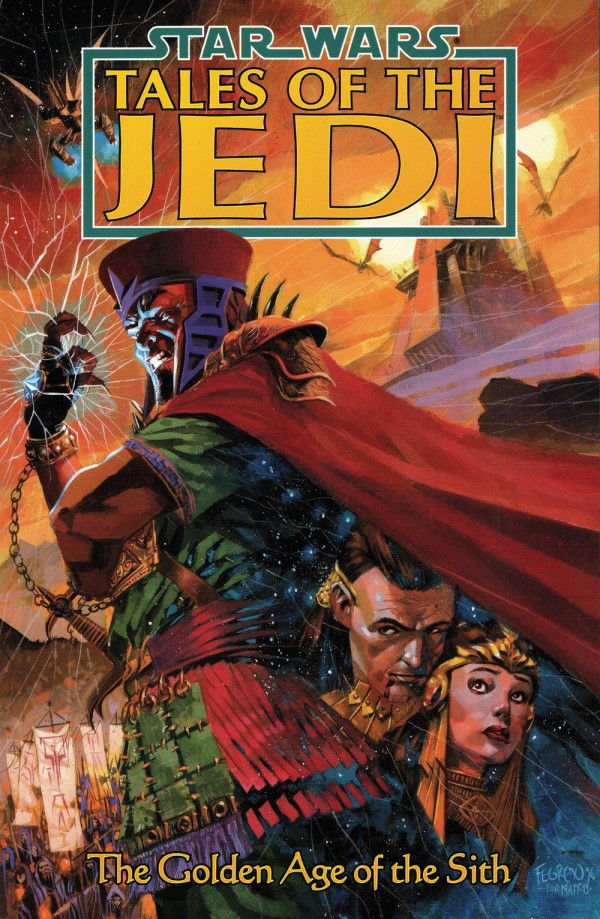 When Tales of the Jedi – The Golden Age of the Sith launched in 1996, Kevin J. Anderson was already one of the most influential architects of the Star Wars Expanded Universe. His work included the Jedi Academy Trilogy, Darksaber, the Young Jedi Knights series with Rebecca Moesta, several bestselling anthology collections, and earlier Tales of the Jedi arcs, including Dark Lords of the Sith and The Sith War, to which The Golden Age of the Sith serves as a prequel. Across novels and comics, Anderson helped develop generations of Jedi, Luke Skywalker’s academy, the Solo children, Exar Kun, and much of the ancient Sith history that would become central to Legends.
Rather than being commissioned to explain the ancient Sith, Anderson and the creative team proposed the story themselves. Seeking guidance about what the Sith had originally been, they submitted a series of questions to George Lucas, whose answers helped provide the foundations for the new mythology. Set around 5,000 BBY, a thousand years before the original Tales of the Jedi stories, The Golden Age of the Sith transformed the Sith from a mysterious title associated with Darth Vader into an ancient species, civilisation, and empire with its own rulers, traditions, rivalries, and monuments.
The first issue opens with its prologue presented on an ancient scroll, immediately reinforcing the feeling that readers are uncovering a forgotten legend from the distant past. Each issue also includes a Star Wars timeline, placing the story some 5,000 years before A New Hope and helping readers understand where this forgotten chapter fits within the wider saga.
The prologue issue was illustrated by Chris Gossett, with Dario Carrasco Jr. providing the artwork for the five-part series that followed. Together, the creative team gave this era a deliberately ancient appearance, featuring weathered starships, ceremonial clothing, monumental Sith architecture, and vast tombs unlike anything previously seen
in the films.
On the opening page, Kevin J. Anderson includes the dedication:
“Special thanks to Tom Veitch, for his help and imagination in creating the ancient Star
Wars Universe.”
The series introduced or greatly developed Korriban, Marka Ragnos, Naga Sadow, Ludo Kressh, the Massassi, and the ancient Sith Empire — concepts that would later become fundamental to Knights of the Old Republic, The Old Republic, and the history of the Sith.
Summary:
Set around 5,000 BBY, Tales of the Jedi – The Golden Age of the Sith begins with Jedi scholar Odan-Urr studying the history of the Dark Jedi who were exiled from the Republic and eventually became rulers of the Sith species. His master, Ooroo, sends him to the Koros system, where Empress Teta is attempting to unite its seven worlds. Alongside Jedi adviser Memit Nadill, Odan-Urr uses battle meditation during the final conflict on Kirrek, helping Teta complete the Unification Wars — although the victory costs the lives of hyperspace pilots Hok and Timar Daragon.
Their children, Gav and Jori Daragon, inherit the heavily indebted Starbreaker 12. Determined to continue their parents’ work as hyperspace explorers, they search for new hyperspace routes that might repay their debts to Aarrba the Hutt. After businessman Ssk Kahorr secretly tests one of their routes and loses a ship near the unstable star Primus Goluud, he blames the Daragons and sends bounty hunters after them. Rescued by Odan-Urr and Memit Nadill, Gav and Jori steal back their repaired ship and escape using untested hyperspace coordinates.
Their random jump carries them beyond known Republic space to Korriban, the burial world of the isolated Sith Empire. They arrive during the funeral of Marka Ragnos, whose death has left the title of Dark Lord of the Sith contested between the expansionist Naga Sadow and the isolationist Ludo Kressh. Their duel is interrupted by the spirit of Ragnos, who warns that the arrival of the outsiders could bring either glory or destruction to the Sith.
Gav and Jori are captured and taken before the Sith Lords on Ziost. Kressh argues that they are Republic spies and should be executed, while Sadow secretly recognises their ship and navigational knowledge as a path into unexplored territory. When the council rules against the Daragons, Sadow engineers their escape. His Massassi warriors slaughter their guards, and Sadow kills his own former mentor, Simus, leaving a Republic weapon behind to make the attack appear to be the beginning of an invasion. Framing the Republic, Sadow manipulates the Sith Lords into supporting him and naming him the new Dark Lord. He separates the Daragons, beginning Gav’s instruction in Sith magic while convincing Jori that he is protecting them. Ludo Kressh, suspicious of Sadow’s story, discovers evidence of the deception and attacks what he believes to be Sadow’s fortress. The stronghold is only a decoy; Sadow ambushes Kressh’s forces, murders two of his rival’s allies through hidden Massassi agents, and drives Kressh into retreat.
Before the battle, Sadow allows Jori to escape aboard the Starbreaker 12, placing a tracking device on the ship. As she races back towards the Republic to find help for Gav, Sadow begins assembling the Sith fleet, intending to follow her route and launch an invasion of a galaxy that has forgotten the Sith still exist.
Thared’s thoughts:
I first saw Tales of the Jedi promoted in the first Dark Horse comic issues I read as a child, and it captured my imagination. Now, nearly thirty years later, reading those stories with my son Ezra made this entry especially enjoyable. The story feels almost like an Arthurian legend — and the emphasis for me is on the word legend. It feels less like a conventional account of galactic history and more like an ancient story that has been passed down through generations: explorers discovering a forgotten kingdom, the death of a powerful ruler, rival claimants battling for succession, warnings from a spirit, and an empire long believed to be myth preparing to return.
The Sith tombs and monuments on Korriban also give me a strong sense of Ancient Egypt and the Valley of the Kings. The enormous statues (reminding me of Jedha), funeral procession, ceremonial clothing, and tombs carved into a dead landscape make the Sith feel like an ancient civilisation rather than simply another group of dark-side Force-users. Even though these comics were created before much of the Old Republic mythology we now take for granted, the visual identity they established still feels inseparable from the Sith.
I really enjoyed the idea of hyperspace exploration: mapping unknown regions of space and making the galaxy feel genuinely vast and unexplored. Gav and Jori’s accidental discovery of the Sith Empire is a simple idea that completely changes galactic history and gives the Star Wars universe a legendary beginning.
One of my favourite characters was Simus. Existing only as a severed head sustained by the dark side, his survival is disturbing but also completely suited to the ancient and mythical atmosphere of this story.
Another part of reading the original comics that I loved was the Jedi Journals letters page. Readers wrote in with their thoughts, questions, criticism, and predictions as the series was being released. Fans including Jenner; Vincent Money (Brooklyn, New York); Tyler Wilson (White Rock, British Columbia, Canada); Chris Jivan (Scottsdale, Arizona); Fernando Neves (Rio de Janeiro, Brazil); Franco Lionetti (Milano, Italy); Mike Shaw; Neal Bungard; Thierry-D. Roy (Montreal, Quebec, Canada); Jason Cook (Cleveland, Tennessee); Shogun Adalric Hargon; Jason R. Anderson; Laura Teddiman; Amy Pronovost; Matthew Wilbur (Santa Rosa, California); Tue Sorensen (Brabrand, Denmark); and Zak Wilson (Grants Pass, Oregon) — their own version of Thared’s Thoughts more than thirty years before this blog, without knowing how important many of these characters and ideas would later become.
More than thirty years later, I can’t help but imagine each of those fans walking into their local comic shop, excited to pick up the latest issue of Star Wars history. Like a Force that continues to bind us together, I wonder where their own Star Wars journeys have taken them.
Article by Jared ‘Thared’ Peppard.