



Journey through the entire Dark Horse Star Wars comics run, one series at a time and in chronological, in-universe order. Between 1991 and 2014, Dark Horse Comics produced over forty individual Star Wars comic series, helping to shape what fans now call Legends, expanding the universe beyond the films. From the birth of the Jedi 25,000 years before the films to the far-future Legacy era, we will chronicle one of the most ambitious Expanded Universe projects in Star Wars history.
Era: Tales of the Jedi
Series: Tales of the Jedi – Knights of the Old Republic
Behind the scenes
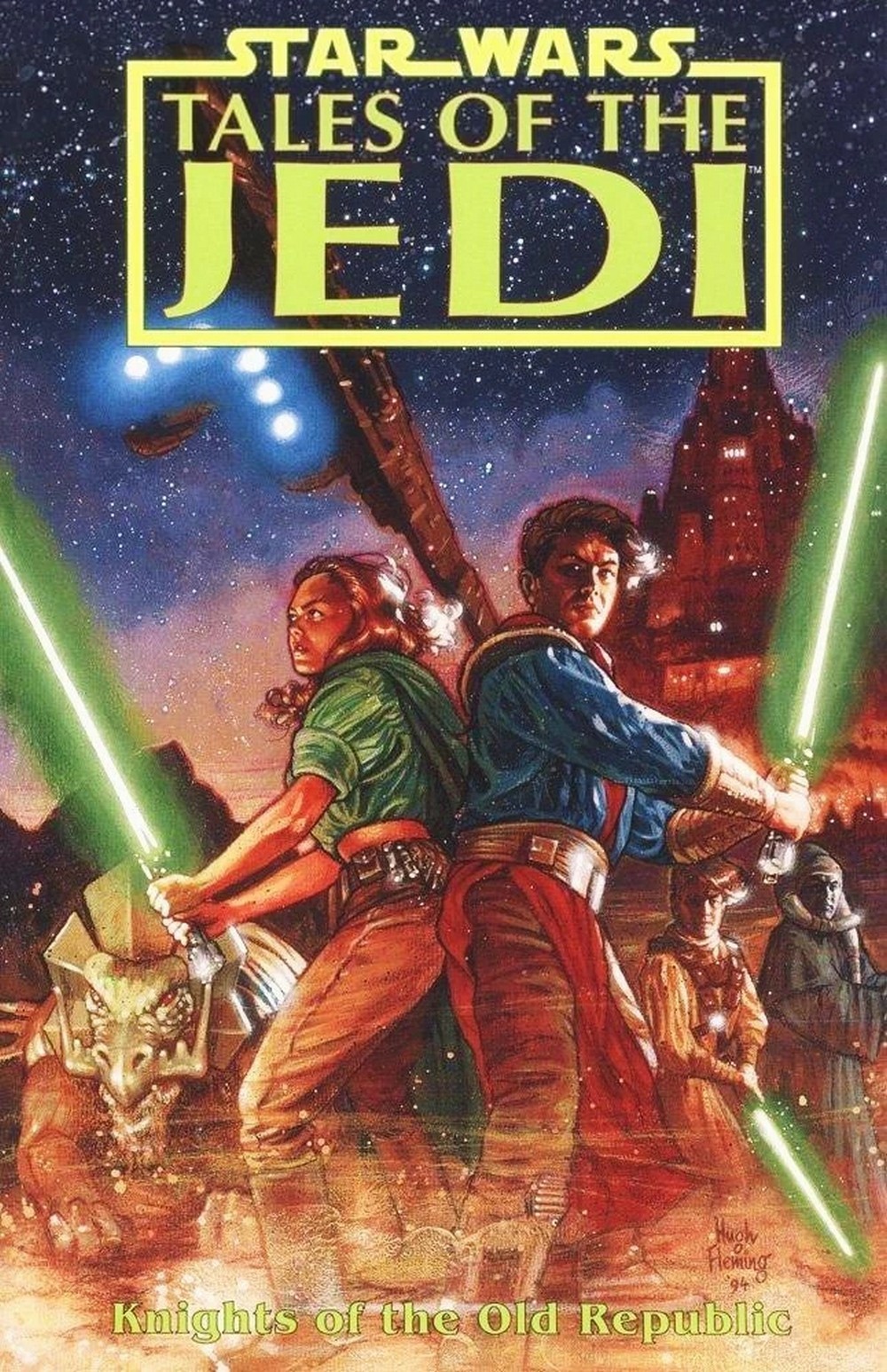 When Star Wars: Tales of the Jedi launched in October 1993, Dark Horse Comics took the Expanded Universe somewhere it had never been before. Rather than continuing the adventures of Luke Skywalker, Han Solo and Princess Leia, writer Tom Veitch travelled approximately 4,000 years into the past, introducing an ancient generation of Jedi Knights and a galaxy whose history had previously existed largely as fragments of legend.
This was the original Tales of the Jedi. Although our chronological journey has already taken us through The Golden Age of the Sith and The Fall of the Sith Empire, those stories were actually published several years later, in 1996 and 1997. Readers picking up the first issue in 1993 encountered Ulic Qel-Droma, the Beast Wars of Onderon and the ancient Jedi Order without the detailed history of Naga Sadow and the Great Hyperspace War that we now have behind us.
The original five-issue series ran from October 1993 to February 1994 and contained two distinct stories. Issues #1–2 featured Ulic Qel-Droma and the Beast Wars of Onderon, illustrated by Chris Gossett, while issues #3–5 told The Saga of Nomi Sunrider, with artwork by Janine Johnston and David Roach. Dave Dorman provided the covers for all five issues.
The stories were subsequently collected in August 1994. The collection was initially released as Tales of the Jedi – The Collection, before becoming known as Tales of the Jedi – Knights of the Old Republic. This additional title helped distinguish the original five-issue story from the subsequent instalments of the expanding Tales of the Jedi saga. It also introduced a name that would become particularly significant to Star Wars fans, eventually being used for BioWare’s acclaimed 2003 video game and Dark Horse’s later comic series of the same name.
The original comic had an interesting publishing history even before its first official issue reached the shelves. The opening twelve pages of Ulic Qel-Droma and the Beast Wars of Onderon were previewed in black and white across six issues of Dark Horse Insider during 1993. Meanwhile, an early version of the first chapter of The Saga of Nomi Sunrider appeared in instalments in Dark Horse Comics #7–9. The Nomi preview contained differences from the version eventually published in Tales of the Jedi #3, offering an intriguing glimpse into the story’s development.
The Jedi Journals letters pages provide another glimpse into the excitement surrounding the series, with some correspondence reacting to advance material shown or distributed around San Diego Comic-Con. Among the contributors was Eli “Skip” Shayotovich, founder and moderator of the FidoNet Star Wars Echo, an early online Star Wars community established in 1991 through a network of computer bulletin-board systems. Tom Veitch himself participated in the Echo, where fans and creators discussed subjects including the Force and the Jedi, making Shayotovich’s correspondence an interesting snapshot of the relationship between early online Star Wars fandom and the creators shaping the Expanded Universe.
Veitch initially envisioned Tales of the Jedi as an anthology, exploring different characters and stories across the ancient Republic rather than concentrating on a single group of protagonists. That approach is apparent in the original five issues. The opening story follows three Jedi apprentices attempting to resolve a centuries-old planetary conflict, while the second introduces a young mother whose life is transformed by tragedy and an unexpected calling to the Force.
The two stories also required different artistic approaches. Chris Gossett established the visual identity of Onderon, its Beast Riders and the ancient Jedi in the opening issues. Janine Johnston, whom Veitch had met at a convention in Glasgow, was brought in to illustrate Nomi Sunrider’s introduction and helped establish the character’s appearance. David Roach then took over for the final two issues, with some artwork requiring adjustments to maintain visual continuity between the artists.
The result was a version of Star Wars that felt familiar yet distinctly ancient. The Jedi were not presented as the centralised institution we would later encounter in the prequel films. Instead, they appeared as wandering knights or Jedi Watchmen, trained by individual Masters and dispatched to distant worlds to mediate disputes, protect communities and confront the dark side. Their clothing, weapons and surroundings gave the series an atmosphere closer to mythological fantasy than the technologically sophisticated Republic of the films.
Onderon provided an ideal setting for this approach. Its fortified capital, Iziz, stood against a dangerous wilderness inhabited by enormous creatures and the descendants of generations of exiles. The conflict between the city’s inhabitants and the Beast Riders initially appeared to be a straightforward struggle between civilisation and its enemies, but the story gradually revealed a much older darkness beneath the planet’s political divisions.
The series introduced several concepts that would become important throughout the wider saga, including Jedi Master Arca Jeth, the moon Dxun and the enduring influence of the ancient Sith Lord Freedon Nadd. Nomi Sunrider’s story subsequently expanded the mythology further through Jedi Master Thon, the planet Ambria and Force abilities that offered an alternative to conventional lightsaber combat.
The title Tales of the Jedi would itself eventually find a new audience. In October 2022, Lucasfilm released an animated anthology of the same name on Disney+, created by Dave Filoni. Its six shorts explored the lives of Ahsoka Tano and Count Dooku during the prequel era. Although the animated series does not adapt the Dark Horse comics or share their ancient setting, the reuse of the title is a reminder of how enduring that original concept has proved: Star Wars stories told through the experiences of different Jedi, across different generations.
For our chronological journey, this edition marks an important transition. A thousand years have passed since the Great Hyperspace War and the collapse of Naga Sadow’s Sith Empire. We are now entering the era in which the surviving legacy of those ancient Sith will begin to threaten a new generation of Jedi, with Ulic Qel-Droma and Nomi Sunrider at the centre of the story.
Summary:
Ulic Qel-Droma and the Beast Wars of Onderon
A thousand years have passed since the Great Hyperspace War and the destruction of the ancient Sith Empire. The Galactic Republic continues to expand, while the Jedi Knights travel between its worlds, maintaining peace and confronting the lingering influence of the dark side.
On the planet Arkania, Jedi Master Arca Jeth prepares three of his apprentices for an important assignment. Ulic Qel-Droma is a gifted and ambitious young Jedi, accompanied by his younger brother Cay Qel-Droma and their Twi’lek companion Tott Doneeta. Although all three have trained under Arca, Ulic is particularly eager to demonstrate that he is ready to act independently.
Their destination is Onderon, a world divided by a conflict that has continued for approximately three hundred years.
Arca Jeth is the Jedi Watchman responsible for the Onderon system, meaning that resolving the conflict falls within his responsibilities. However, rather than travelling there himself, he entrusts the mission to Ulic, Cay and Tott, believing that his apprentices are ready to undertake an important assignment without his direct supervision. It is effectively a test of their ability to act as Jedi Knights rather than simply as students, with Ulic taking responsibility for leading the mission.
Arca explains that Onderon’s moon, Dxun, follows an unusually close orbit. During periodic atmospheric contact between the two worlds, dangerous creatures originally crossed from Dxun to Onderon. The inhabitants eventually constructed the fortified city of Iziz to protect themselves from the planet’s hostile wilderness.
Over time, Iziz developed a brutal practice of banishing criminals beyond its walls. Many of the exiles survived, adapted to their surroundings and learned to tame the enormous flying creatures inhabiting the wilderness. Their descendants became known as the Beast Riders, and generations of warfare followed between the riders and the inhabitants of Iziz.
The Jedi arrive in Iziz and meet Queen Amanoa, the planet’s ruler, and her daughter Princess Galia. Amanoa presents the Beast Riders as violent enemies who threaten the city’s inhabitants and have resisted every attempt to establish peace.
Before the Jedi can fully investigate, Beast Riders launch a daring attack on the royal palace. Riding their enormous winged creatures, they break into the throne room and abduct Princess Galia.
Amanoa demands that the Jedi rescue her daughter, and Ulic immediately pursues the kidnappers into the wilderness with Cay and Tott.
Their mission quickly becomes more complicated when their ship is attacked and brought down by the Beast Riders. Stranded beyond Iziz, the three Jedi discover that the supposedly savage exiles possess an organised society, military capabilities and a very different understanding of the centuries-long conflict.
The Beast Riders are led by Oron Kira, a young warrior who has fallen in love with Princess Galia. Her apparent kidnapping is not simply an act of aggression against Iziz.
Galia wishes to be with Oron, and their relationship offers a possible means of ending the war between the city’s inhabitants and the exiles.
As the Jedi learn more about the conflict, they begin to realise that Queen Amanoa’s account has concealed the true nature of Onderon’s political divisions.
The hostility between Iziz and the Beast Riders is rooted not merely in generations of resentment, but in the influence of Freedon Nadd, an ancient Sith Lord whose dark-side teachings have shaped the planet’s ruling dynasty.
Although Nadd himself is long dead, his spirit and legacy continue to exert influence through the royal family. Amanoa has embraced the dark side and uses its power to maintain her authority, ensuring that the conflict continues rather than allowing reconciliation.
Ulic, Cay and Tott attempt to bring Princess Galia and Oron Kira together with the people of Iziz, but Amanoa refuses to surrender her power. The conflict escalates into a full-scale battle as the Beast Riders launch an assault on the city.
The Jedi find themselves caught between the two armies. Ulic’s confidence and combat abilities are tested, but the scale of the conflict reveals the limitations of his experience.
He cannot resolve the crisis through courage and lightsaber skill alone.
Recognising the growing danger, Master Arca Jeth travels to Onderon to assist his apprentices.
Arca’s arrival changes the course of the battle. Drawing upon his mastery of the Force, he confronts the dark-side influence surrounding Queen Amanoa and helps break its hold over the conflict.
Amanoa dies, and the power she wielded through Freedon Nadd is defeated. With the Queen gone, Princess Galia is free to marry Oron Kira, creating a political union between Iziz and the Beast Riders.
After three centuries of warfare, Onderon finally has an opportunity for peace.
For Ulic, however, the mission is also a lesson in the responsibilities of a Jedi. His enthusiasm and natural ability were not enough to recognise the full nature of the conflict.
Arca’s intervention demonstrates the importance of patience, wisdom and understanding the forces operating behind an apparently straightforward dispute.
The victory also leaves an unresolved danger. Freedon Nadd’s influence has been weakened, but the ancient Sith Lord’s remains and the dark-side cult surrounding his memory have not been destroyed.
That surviving legacy will become the central threat of the next story, The Freedon Nadd Uprising.
The Saga of Nomi Sunrider
Elsewhere in the Republic, another Jedi’s journey begins under very different circumstances.
Nomi Sunrider is travelling with her husband, Andur Sunrider, and their young daughter, Vima. Andur is a Jedi Knight who intends to continue his training under the legendary Jedi Master Thon, a powerful and mysterious being living on the planet Ambria.
Nomi is sensitive to the Force but has never wished to become a Jedi herself. She is content to support Andur’s ambitions while caring for their daughter, and the family looks forward to beginning a new life on Ambria.
Andur carries a valuable collection of Adegan crystals, intended for use in constructing lightsabers. Their value attracts the attention of Bogga the Hutt, a powerful criminal who operates through hired thugs and agents.
When the Sunrider family stops at a spaceport on their journey, Bogga’s men attempt to steal the crystals.
Andur confronts the attackers, but the encounter ends in tragedy. One of the criminals unleashes poisonous creatures against him, and Andur is killed before he can defend himself.
Nomi is left alone with Vima, facing the sudden loss of her husband and the threat of the criminals who have murdered him.
In the aftermath of Andur’s death, Nomi experiences a vision of his spirit. He urges her to take up his lightsaber and defend herself and their daughter.
Although she has resisted the idea of becoming a Jedi, Nomi is forced to act. She takes Andur’s weapon and fights the attackers, discovering that her connection to the Force is far stronger than she had previously allowed herself to believe.
She escapes with Vima and continues the journey to Ambria, determined to honour Andur’s final wish by finding Master Thon.
When Nomi arrives, she is surprised to discover that Thon is not the humanoid Jedi Master she had imagined. He is an enormous, armoured, four-legged creature whose appearance resembles one of the strange beasts inhabiting the planet.
Despite his intimidating appearance, Thon is a wise and compassionate Jedi with an exceptionally powerful connection to the Force.
Nomi explains what happened to Andur and asks Thon to train her, although she remains deeply uncertain about whether she truly wishes to become a Jedi.
Thon recognises her potential and begins teaching her to trust the Force. He also understands that Nomi’s greatest obstacle is not a lack of ability but her fear of accepting the responsibility and danger that accompany a Jedi’s life.
Ambria itself provides an important lesson.
Long before Nomi’s arrival, the planet had been devastated by a dark-side catastrophe. A Jedi attempting to cleanse the world of its corruption had unleashed destructive energies, leaving much of Ambria barren and lifeless.
Thon eventually succeeded in containing the dark-side power within a lake, allowing the surrounding world to begin recovering. The lake remains a dangerous concentration of dark-side energy, demonstrating the lasting consequences of attempting to control powers that cannot easily be understood.
As Nomi’s training progresses, she discovers an unusual ability to influence the connection between another being and the Force. Rather than relying exclusively on a lightsaber, she can use the Force to disrupt an opponent’s ability to draw upon it.
She also begins developing the power of Jedi battle meditation, through which a Jedi can influence the morale, coordination and effectiveness of others during a conflict.
These abilities establish Nomi as a Jedi whose strength lies as much in her understanding of the Force as in conventional combat.
Meanwhile, Bogga the Hutt remains determined to acquire the Adegan crystals. His agents track Nomi to Ambria, and the criminal organisation prepares another attempt to seize the valuable cargo.
The threat forces Nomi to confront the fear and uncertainty that have followed her since Andur’s death.
Thon initially allows her to face the danger as part of her training, trusting that she must discover her own strength rather than depend entirely upon his protection.
When Bogga’s forces arrive, Nomi is drawn into another confrontation. This time, however, she is no longer simply a frightened widow defending her daughter.
Drawing upon her growing mastery of the Force, she resists the attackers and helps defeat the criminals threatening Ambria.
Bogga’s attempt to steal the crystals fails, and Nomi survives the ordeal with a new understanding of her abilities.
She finally accepts that her connection to the Force cannot be separated from the responsibilities Andur had hoped to fulfil. Although she never intended to become a Jedi, the tragedy of his death has led her towards a different future.
With Vima beside her and Thon continuing to guide her, Nomi commits herself to the Jedi path.
The series concludes with two young Jedi whose lives have taken very different directions. Ulic Qel-Droma has learned that talent and ambition must be tempered by wisdom, while Nomi Sunrider has discovered extraordinary strength through grief and an initially reluctant acceptance of her destiny.
Their stories are separate for now, but both will become central to the conflicts that threaten the Republic in the years ahead.
Thared’s thoughts:
Tales of the Jedi feels like the Star Wars history I had imagined as a child. Alongside Knights of the Old Republic, this is how I pictured the galaxy thousands of years before Luke Skywalker, although Tales of the Jedi definitely feels more ancient. I’ve always felt as though Knights of the Old Republic should have been set a thousand years or so after Tales of the Jedi.
This series reminds me of Greek mythology, the fantastical worlds of older films such as Atlantis, the Lost Continent (1961), and the sword-and-sorcery adventures of He-Man and the Masters of the Universe — especially the Beast Riders! Star Wars is generational. Different themes, styles and influences have been popular throughout its history, and I appreciate how challenging it must have been to keep thousands of years of galactic legends feeling like one coherent universe.
Despite enjoying Dawn of the Jedi, I connect more strongly with Tales of the Jedi. Dawn of the Jedi takes place much further in the past, but the older comic-book artwork and fantasy influences make it feel older to me. It feels like an ancient legend being brought to life rather than a modern story set in an ancient period.
I particularly love the idea of Jedi Watchmen. Master Arca Jeth is responsible for the Onderon system, but he entrusts the conflict to his apprentices as an opportunity for them to prove themselves. These Jedi feel like wandering knights, travelling between worlds, protecting communities and resolving disputes. It’s much closer to how I imagined the ancient Jedi Order than the more formal, sanitised institution we see in the prequel films.
Onderon itself is really interesting. A fortified city surrounded by dangerous wilderness, flying beasts, generations of exiles and an ancient Sith influence. I love that Onderon has continued to appear in Star Wars storytelling, including The Clone Wars and The Bad Batch. Seeing a world introduced in these comics find a place in stories years later makes the galaxy feel connected.
Tott Doneeta is a character who stood out to me. His ability to understand and connect with the beasts reminded me of Ezra Bridger, whose connection to animals is one of my favourite aspects of Star Wars Rebels. It’s a reminder that the Force isn’t simply about moving objects or wielding a lightsaber. It connects living things, and some Jedi seem particularly attuned to that relationship.
I also love seeing the yellow lightsaber in Tales of the Jedi, with the original Kenner Luke Skywalker figure famously carrying a yellow lightsaber.
Then there’s Cay Qel-Droma losing an arm and receiving a mechanical replacement. You can hardly have a proper Star Wars adventure without somebody losing a limb!
The line about letting go of the past also stood out to me. It’s an idea that Star Wars has returned to repeatedly, particularly in stories about the Jedi, their traditions and the burden of history.
The Saga of Nomi Sunrider reminding me of a Greek tragedy, is such a unique Jedi story, even though her name feels unmistakably Star Wars.
I love the opening description of the galaxy: “Before the development of hyperspace travel, star systems lived in great isolation from one another. Millions of civilisations rose and fell without ever learning of each other’s existence.”
The reveal of Master Thon was great. Nomi travels all that way expecting to meet a legendary Jedi Master, only to discover that the enormous armoured creature she encounters is Thon himself. It reminded me of Luke meeting Yoda in The Empire Strikes Back, and how our expectations of what a great Jedi Master should look like can be completely turned on their head.
Bogga the Hutt and his lair inevitably reminded me of Jabba’s Palace, but one of my favourite scenes came in issue #5. Seeing Nomi Sunrider on page six took me back to The Essential Guide to Characters from 1995, which I obsessed over as a kid, long before I had read many of the stories these characters actually came from.
The Jedi Journals are still almost as interesting to me as the comics themselves. One reader asked how often Dark Horse conversed with George Lucas, with the response: ‘In the case of particularly bold plot ideas, George Lucas himself steps in for some much appreciated insight (and inspiration).’ Martin Thurn, who ran The Star Wars Collector newsletter, also wrote in — another little glimpse into the Star Wars fan community of the early 1990s.
And, apparently, if you wanted to order the comics, you could simply call (0800) 862-0052 between 1:00 and 4:00 PM!
Bonus – A long time ago, when I was sixteen years old…
When I was sixteen, I was working three days a week with an electrician, for free, trying to prove myself and earn an apprenticeship. I was at college two days a week and worked a Saturday job at an opticians, like I had done for my school work experience.
A Star Wars fan who was working at the opticians when I started was leaving to start his own business selling vintage Star Wars figures. When I told him I loved Star Wars, he told me about Star Wars Celebration Europe, taking place the following year.
Growing up, I felt like I had a childhood that passed me by. We didn’t ever really do anything spontaneous or adventurous, and the idea of going to an event dedicated entirely to Star Wars seemed unimaginable — I promised myself that I wasn’t going to miss it!
I didn’t have a clue how to go about finding out more about it, let alone book tickets… Fortunately, I had one nerdy friend — a “Kirk-lovin’ Spock-sucker” — who knew what he was doing and booked us a couple of tickets.

Celebration Europe in 2007 was amazing.
For the first time, I found myself surrounded by like-minded Star Wars fans. They weren’t there because Star Wars was fashionable or because a new film was coming out. They were there because they genuinely loved it.
I met Chewbacca, Peter Mayhew — although I’ll have more to say about that encounter in a future edition — and saw Luke Skywalker, Mark Hamill, live on stage. And I came home with two comics: Tales of the Jedi.
Looking back, I honestly attribute that determination to attend Celebration Europe as one of the first steps towards following my dreams. It was a moment when I decided that something mattered enough to me that I was going to make it happen, no matter what — a path that would ultimately lead to Thared.
Article by Jared ‘Thared’ Peppard.