



In a film packed with exciting action sequences, the Dragonsnake sequence on Nal Hutta stands out as a must-see in The Mandalorian and Grogu, and writing over at ILM.com I had the great fortune of chatting with the team behind these confined, murky, watery moments (Tania Richard, Ken Beauchamp, Michael Goddard, Michael Dharney and Jason Madigan) about how to bring a snake the length of a football field to life.
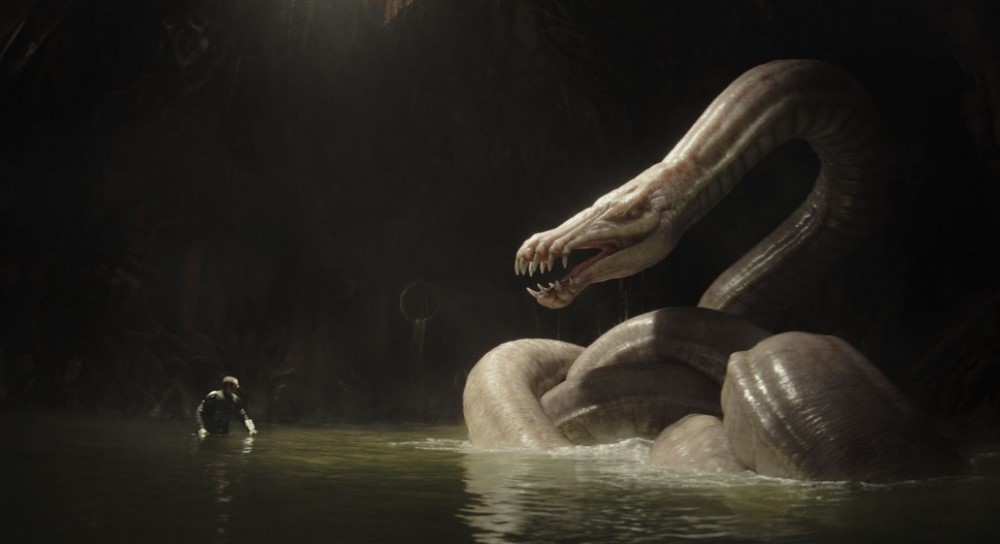
ILM is world-renowned for rising to such challenges. “The activity was changing, the location was changing, you’ve got the snake wrapped around Mando, and the snake head was filmed with a large on-set animatronic,” Madigan continues. “We couldn’t use that, so we had to remove it.” Additionally, the water itself became a key focus of their work. “Each shot had to be approached differently. It wasn’t something we could set up and say, ‘This is how we do the underwater stuff.’ Every shot was a puzzle to decipher.”
Bringing these elements together meant some creative thinking was required, as Goddard explains. “The water was murky when we looked down from above, but from a storytelling standpoint, you need to ‘de-murk’ it when you’re underwater, otherwise you can’t see anything, so a lot of the underwater roots weren’t necessary for the above water shots. That gave the animation team the freedom to do whatever they wanted to with the snake and not worry about it crashing through stuff, because you couldn’t see it.”
The murky water was also laced with some additional texture. “We had a comp treatment that added a bit of surface texture and dirt, which was pretty simple, but it only worked in certain circumstances,” says Madigan, “but the more you have to play with underwater, the easier it’s going to be to sell it as actually having content in the water volume between you and other objects. The amount of layered murky components that we put in some of those underwater shots was pretty high.”