

How ILM used paintings and maquettes to help bring the younger Dial of Destiny Indiana Jones to life

- Advertisement -
- Advertisement -

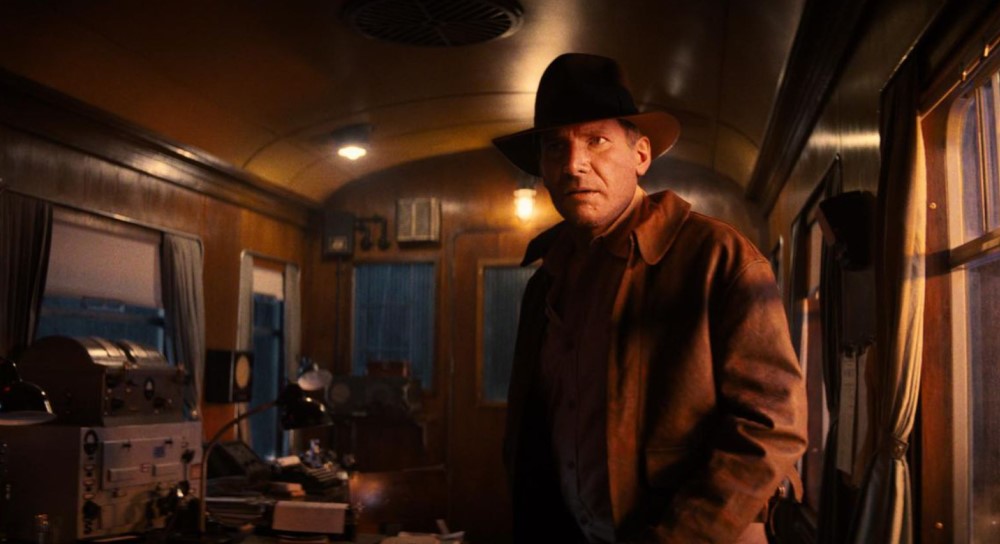
The creation by ILM VFX of the younger Indiana Jones who led the opening 20 minutes of last summers Oscar nominated Indiana Jones and the Dial of Destiny involved a number of disciplines, including some unique and surprising ones. befores & afters take a look at some of these processes which brought a mid-40’s Indy to life.

b&a: For the de-ageing of Harrison Ford, on set, what were some of the things done to help capture reference of the actor, in terms of camera set-up, lighting ref, etc?

Andrew Whitehurst: We used as many approaches as possible to ensure we maximized our coverage of the action. We used the FLUX facial capture rig, which attached two additional cameras on either side of the main taking camera that provided us with additional angles on the performance to help in producing 3D solves of the performance. We also scanned the sets, and shot lighting reference for every set up so we could precisely align all the CG geometry to the set, and accurately replicate the lighting for every angle.

Prior to shooting we had scanned Harrison Ford running through a full set of possible facial shapes, again to allow for more precise facial tracking of the source performance.

b&a: I heard you or ILM may have done some individual hand-made paintings and sculpted maquettes to aid in the process–can you talk about the intention of these?

Andrew Whitehurst: My background is in fine art and I was always taught that the best way to try and visually understand something is to draw, paint, or sculpt it. You have to start with a blank sheet or ball of clay, look at a lot of reference, and don’t trace anything, just draw or sculpt based on observation. The point is not necessarily to create a beautiful finished piece but to really force yourself to look hard at your subject, and the best way to do that is to try and create your own version from scratch.

I did a lot of paintings and drawings throughout the production, and a small maquette sculpt during pre-production, and I learned something about Harrison’s likeness with every one. Some ended up being more successful than others as finished pieces, but you learn a lot from the disasters, arguably more than from the ‘successes’. I really recommend hand crafted visual studies as part of the creative process, even for folks who don’t think they can draw, because the finished piece isn’t the important part, it’s the process of what you learn trying to make it which is invaluable.

Mark Newbold
Mark Newbold
Exploring the galaxy since 1978, Mark wrote his first fan fiction in '81 and been a presence online since his first webpage Fanta War in 1996. He currently contributes to ILM.com and SkywalkerSound.com, having previously written for Star Wars Insider, StarWars.com, Star Wars Encyclopedia, Build The Millennium Falcon, Starburst Magazine, Geeky Monkey, TV Film Memorabilia and Model and Collectors Mart. He is a four-time Star Wars Celebration Stage host (the only podcaster to have appeared on every Celebration podcast stage since it began in 2015), the Daily Content Manager of Fantha Tracks and the co-host of Making Tracks, Canon Fodder and Start Your Engines on Fantha Tracks Radio.
- Advertisement -
- Advertisement -

The creation by ILM VFX of the younger Indiana Jones who led the opening 20 minutes of last summers Oscar nominated Indiana Jones and the Dial of Destiny involved a number of disciplines, including some unique and surprising ones. befores & afters take a look at some of these processes which brought a mid-40’s Indy to life.

b&a: For the de-ageing of Harrison Ford, on set, what were some of the things done to help capture reference of the actor, in terms of camera set-up, lighting ref, etc?

Andrew Whitehurst: We used as many approaches as possible to ensure we maximized our coverage of the action. We used the FLUX facial capture rig, which attached two additional cameras on either side of the main taking camera that provided us with additional angles on the performance to help in producing 3D solves of the performance. We also scanned the sets, and shot lighting reference for every set up so we could precisely align all the CG geometry to the set, and accurately replicate the lighting for every angle.

Prior to shooting we had scanned Harrison Ford running through a full set of possible facial shapes, again to allow for more precise facial tracking of the source performance.

b&a: I heard you or ILM may have done some individual hand-made paintings and sculpted maquettes to aid in the process–can you talk about the intention of these?

Andrew Whitehurst: My background is in fine art and I was always taught that the best way to try and visually understand something is to draw, paint, or sculpt it. You have to start with a blank sheet or ball of clay, look at a lot of reference, and don’t trace anything, just draw or sculpt based on observation. The point is not necessarily to create a beautiful finished piece but to really force yourself to look hard at your subject, and the best way to do that is to try and create your own version from scratch.

I did a lot of paintings and drawings throughout the production, and a small maquette sculpt during pre-production, and I learned something about Harrison’s likeness with every one. Some ended up being more successful than others as finished pieces, but you learn a lot from the disasters, arguably more than from the ‘successes’. I really recommend hand crafted visual studies as part of the creative process, even for folks who don’t think they can draw, because the finished piece isn’t the important part, it’s the process of what you learn trying to make it which is invaluable.

Mark Newbold
Mark Newbold
Exploring the galaxy since 1978, Mark wrote his first fan fiction in '81 and been a presence online since his first webpage Fanta War in 1996. He currently contributes to ILM.com and SkywalkerSound.com, having previously written for Star Wars Insider, StarWars.com, Star Wars Encyclopedia, Build The Millennium Falcon, Starburst Magazine, Geeky Monkey, TV Film Memorabilia and Model and Collectors Mart. He is a four-time Star Wars Celebration Stage host (the only podcaster to have appeared on every Celebration podcast stage since it began in 2015), the Daily Content Manager of Fantha Tracks and the co-host of Making Tracks, Canon Fodder and Start Your Engines on Fantha Tracks Radio.
- Advertisement -
- Advertisement -
- Advertisement -