


Lucas Museum: How the landscape tells a story

- Advertisement -
- Advertisement -

While our interests naturally gravitate towards any Lucasian elements of the Lucas Museum of Narrative Art, the endeavour is about far more than galaxy-spanning adventures, diminutive wizards or intrepid archaeologists. The LMNA is truly designed to be part of Los Angeles, and this piece over at the Los Angeles Times hones in on the ‘Foothills, groves, canyons and mesas all have been created above a parking garage thanks to the abundant use of hidden foam to shape the terrain‘.
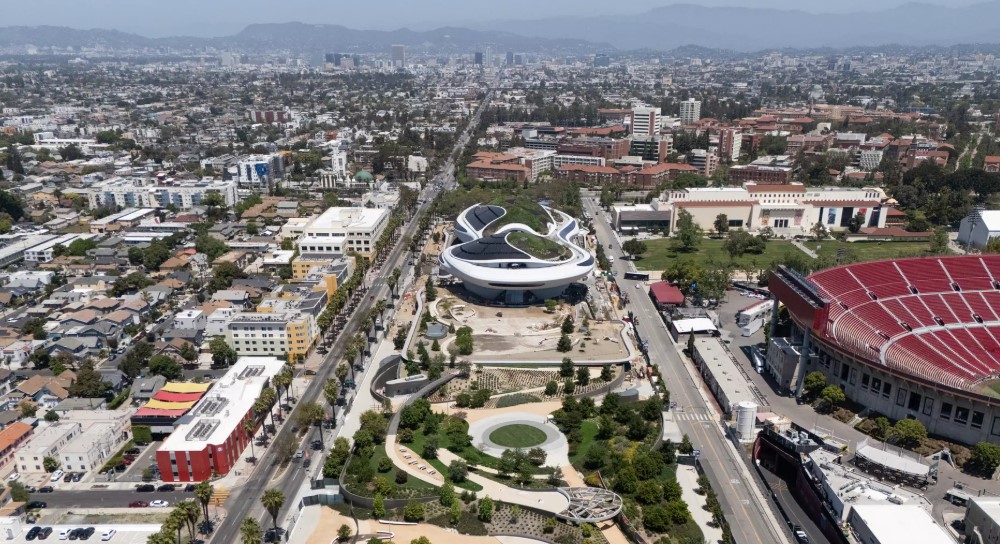
A long stretch of park space extends from the Lucas Museum of Narrative Art, which sits next to the Los Angeles Memorial Coliseum. (Myung J. Chun / Los Angeles Times)

“We looked at the landscapes of myths and movies,” said Kush Parekh, a principal at Studio-MLA. “How do you take someone on a journey through space? How does the terrain change the story — and how can it be the story?”

The result — which feels surprisingly grown-in even though the museum won’t open until next year — is a sinuous, eclectic landscape that unfolds in discrete vignettes, all promoting exploration and distinct experience. Each zone contains varied textures, colors, scales and often framed views. A shaded walkway curls along a meandering meadow and lifts you toward a hilly canyon. A footbridge carries you above a developing conifer thicket. A plant-covered trellis, known as “the hanging garden,” provides a more compressed moment of pause. The environment, like a good story, continually shifts tone and tempo.

“It’s episodic,” Parekh said. “Each biome reveals something new, each path hints at what’s ahead without giving it away.”

A key theme of the story is the diverse terrain of California — a place that, in Lehrer’s words, “contains more varied environments in a single day’s drive than most countries do in a week.” Foothills and valleys, groves and canyons, even the mesas, plateaus and plains of the Sierra and the Central Valley — Lehrer calls all of it a “choreography of place.”

Mark Newbold
Mark Newbold
Exploring the galaxy since 1978, Mark wrote his first fan fiction in '81 and been a presence online since his first webpage Fanta War in 1996. He currently contributes to ILM.com and SkywalkerSound.com, having previously written for Star Wars Insider, StarWars.com, Star Wars Encyclopedia, Build The Millennium Falcon, Starburst Magazine, Geeky Monkey, TV Film Memorabilia and Model and Collectors Mart. He is a four-time Star Wars Celebration Stage host (the only podcaster to have appeared on every Celebration podcast stage since it began in 2015), the Daily Content Manager of Fantha Tracks and the co-host of Making Tracks, Canon Fodder and Start Your Engines on Fantha Tracks Radio.
- Advertisement -
- Advertisement -

While our interests naturally gravitate towards any Lucasian elements of the Lucas Museum of Narrative Art, the endeavour is about far more than galaxy-spanning adventures, diminutive wizards or intrepid archaeologists. The LMNA is truly designed to be part of Los Angeles, and this piece over at the Los Angeles Times hones in on the ‘Foothills, groves, canyons and mesas all have been created above a parking garage thanks to the abundant use of hidden foam to shape the terrain‘.

A long stretch of park space extends from the Lucas Museum of Narrative Art, which sits next to the Los Angeles Memorial Coliseum. (Myung J. Chun / Los Angeles Times)

“We looked at the landscapes of myths and movies,” said Kush Parekh, a principal at Studio-MLA. “How do you take someone on a journey through space? How does the terrain change the story — and how can it be the story?”

The result — which feels surprisingly grown-in even though the museum won’t open until next year — is a sinuous, eclectic landscape that unfolds in discrete vignettes, all promoting exploration and distinct experience. Each zone contains varied textures, colors, scales and often framed views. A shaded walkway curls along a meandering meadow and lifts you toward a hilly canyon. A footbridge carries you above a developing conifer thicket. A plant-covered trellis, known as “the hanging garden,” provides a more compressed moment of pause. The environment, like a good story, continually shifts tone and tempo.

“It’s episodic,” Parekh said. “Each biome reveals something new, each path hints at what’s ahead without giving it away.”

A key theme of the story is the diverse terrain of California — a place that, in Lehrer’s words, “contains more varied environments in a single day’s drive than most countries do in a week.” Foothills and valleys, groves and canyons, even the mesas, plateaus and plains of the Sierra and the Central Valley — Lehrer calls all of it a “choreography of place.”

Mark Newbold
Mark Newbold
Exploring the galaxy since 1978, Mark wrote his first fan fiction in '81 and been a presence online since his first webpage Fanta War in 1996. He currently contributes to ILM.com and SkywalkerSound.com, having previously written for Star Wars Insider, StarWars.com, Star Wars Encyclopedia, Build The Millennium Falcon, Starburst Magazine, Geeky Monkey, TV Film Memorabilia and Model and Collectors Mart. He is a four-time Star Wars Celebration Stage host (the only podcaster to have appeared on every Celebration podcast stage since it began in 2015), the Daily Content Manager of Fantha Tracks and the co-host of Making Tracks, Canon Fodder and Start Your Engines on Fantha Tracks Radio.
- Advertisement -
- Advertisement -
- Advertisement -